Uncrewed fleets emerge as AUKUS nations’ answer to capability interval
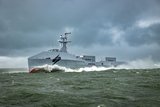
The Kraken USV being piloted in the Solent. (Photo: UK Royal Navy)
While their multibillion-dollar nuclear submarine ambitions move forward at a glacial industrial pace, all three countries are making a swifter bet: fleets of uncrewed vessels that can be built, deployed and iterated in years rather than decades.


Australia, the UK and the US are fielding autonomous maritime platforms to plug capability gaps while long-term submarine programmes face protracted timelines.
Within the space of a single week in March 2026, the three nations that form the AUKUS trilateral security partnership each announced commitments to uncrewed maritime systems.
Australia invested A$176 million (US$125 million) in a fleet of Bluebottle uncrewed surface vessels (USVs) for the Royal Australian Navy (RAN). The UK Royal Navy confirmed a £12.3 million (US$16.4 million) contract for 20 USVs under Project Beehive.
Across the Atlantic, the Defense Innovation Unit (DIU) and the US Navy selected
Our news & analysis is now part of Defence Insight®
A Basic-level or higher Defence Insight subscription is now required to view this content.

More from Naval Warfare
-
![Competitive P17B tender marks a shift in Indian Navy frigate procurement]()
Competitive P17B tender marks a shift in Indian Navy frigate procurement
The Indian Navy's P17B programme is expected to combine greater weapons capacity with a competitive domestic construction model, although key systems could remain dependent on international supply chains.
-
![China’s mineral processing dominance exposes naval supply chain vulnerabilities]()
China’s mineral processing dominance exposes naval supply chain vulnerabilities
Competition for critical minerals, and China’s dominance of their processing, is emerging as a decisive factor in future naval procurement programmes.
-
![Suppliers await next step in Australia’s mine warfare transition]()
Suppliers await next step in Australia’s mine warfare transition
Australia’s mine countermeasure capability remains in flux as the Huon-class nears retirement, but accelerated investment in autonomous systems is opening a path for industry.
-
![Can the US Navy ask Indo-Pacific allies to do more while training with them less?]()
Can the US Navy ask Indo-Pacific allies to do more while training with them less?
As the Iran War draws US ships and marine corps units away from the Indo-Pacific, curtailed exercises and a temporary carrier gap are exposing tensions between Washington’s demand for more self-reliant allies and the joint training needed to realise that ambition.