US Navy seeks laser weapons


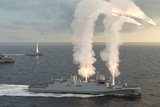
Northrop Grumman has been selected to design and produce a Laser Weapon System Demonstrator (LWSD) by the US Office of Naval Research, the company announced on 22 December.
The contract, awarded in October, will see Northrop Grumman take forward development under a three phase programme. This will include a design, production, integration and testing of a 150-kilowatt-class solid state (electric) laser weapon system.
Phase one will see the company develop a detailed design for the new system, while phase two will include assembly and ground testing. Phase three will comprise at-sea testing aboard the navy’s Self Defense Test Ship (SDTS).
The initial award of $53 million will support work planned for the next 12 months. With all contract options exercised the value could grow to $91 million over 34 months.
Guy Renard, director and program manager, directed energy, Northrop Grumman Aerospace Systems, said: ‘Northrop Grumman is integrating the latest in high energy lasers with more than 40 years of experience as a laser weapon system integrator to protect sailors against last-minute, high impact threats.
‘For about the price of a gallon of diesel fuel per shot, we’re offering the navy a high-precision defensive approach that will protect not only its sailors, but also its wallet.’

You may also like
More from Naval Warfare
-
![Suppliers await next step in Australia’s mine warfare transition]()
Suppliers await next step in Australia’s mine warfare transition
Australia’s mine countermeasure capability remains in flux as the Huon-class nears retirement, but accelerated investment in autonomous systems is opening a path for industry.
-
![Can the US Navy ask Indo-Pacific allies to do more while training with them less?]()
Can the US Navy ask Indo-Pacific allies to do more while training with them less?
As the Iran War draws US ships and marine corps units away from the Indo-Pacific, curtailed exercises and a temporary carrier gap are exposing tensions between Washington’s demand for more self-reliant allies and the joint training needed to realise that ambition.
-
![How could Rheinmetall’s GMF 140 fit with ongoing programmes in North America?]()
How could Rheinmetall’s GMF 140 fit with ongoing programmes in North America?
With Canada committed to its River-class replacement and the USN pursuing a lower-cost frigate, Rheinmetall will need to demonstrate where the GMF 140 can fill a capability gap in the North American fleet.
-
![Australian industry programme builds pipeline for Virginia-class sustainment]()
Australian industry programme builds pipeline for Virginia-class sustainment
Australian businesses can now bid to support Virginia-class submarine sustainment in Western Australia, as momentum around the Henderson Defence Precinct also builds.
-
![South Korea, Japan and Turkey vie for US shipbuilding access in future frigate contest]()
South Korea, Japan and Turkey vie for US shipbuilding access in future frigate contest
Washington’s search for a foreign-built frigate could hand South Korea, Japan and Turkey a larger prize than a double-hull order: a foothold inside the US shipbuilding industrial base.