Tomahawk naval missile completes production acceptance test


The US Navy’s Tomahawk land attack missile completed a production acceptance test using functional ground test (FGT) capability on 19 March.
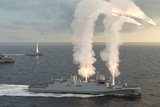
The all-weather, long-range, sub-sonic cruise missile can be used for land warfare, and is launched from naval surface ships and submarines.
Michael Spriggs, senior engineer and FGT test conductor, Naval Surface Warfare Center, said: ‘This latest FGT - which is the 84th we’ve conducted in the past 25 years - was in support of the RGM-109E Block IV, Vertical Launch System (VLS) full-rate production lot acceptance.
‘For the test, we used a single, representative missile from the full-rate production line to demonstrate the capability of this lot to perform mission requirements. The data we collected from the test will be used to verify the manufacturing processes and quality of missiles produced.’
During the test, the missile is operated at the level that it would be exercised in an operational flight through the detonation command. However, the missile remains restrained in a specially-designed test stand and is fitted with an inert warhead.
Mike Gardner, FGT software lead, Naval Surface Warfare Center, said: ‘After launch, real-time, six-degree-of-freedom accredited mission simulation software provides inputs to the missile’s guidance system to mimic flight, targeting and detonation. The missile ‘flew’ for about an hour and 45 minutes before it successfully acquired the target.’
Spriggs added: ‘Preliminary assessment indicates this missile performed as expected and all test objectives were achieved.’
Phillip Vaughn, FGT program manager, Naval Surface Warfare Center, said: ‘We anticipate conducting the next FGT later this fiscal year to sample a capsule launching system variant.’

You may also like
More from Naval Warfare
-
![How France’s SNLE 3G programme is reshaping the naval nuclear industrial base]()
How France’s SNLE 3G programme is reshaping the naval nuclear industrial base
Extending far beyond a four-submarine replacement programme, France’s ballistic missile submarine effort is a decades-long industrial effort designed to preserve the country’s ability to build and sustain nuclear-powered strategic platforms.
-
![China’s mineral processing dominance exposes naval supply chain vulnerabilities]()
China’s mineral processing dominance exposes naval supply chain vulnerabilities
Competition for critical minerals, and China’s dominance of their processing, is emerging as a decisive factor in future naval procurement programmes.
-
![Suppliers await next step in Australia’s mine warfare transition]()
Suppliers await next step in Australia’s mine warfare transition
Australia’s mine countermeasure capability remains in flux as the Huon-class nears retirement, but accelerated investment in autonomous systems is opening a path for industry.
-
![Can the US Navy ask Indo-Pacific allies to do more while training with them less?]()
Can the US Navy ask Indo-Pacific allies to do more while training with them less?
As the Iran War draws US ships and marine corps units away from the Indo-Pacific, curtailed exercises and a temporary carrier gap are exposing tensions between Washington’s demand for more self-reliant allies and the joint training needed to realise that ambition.
-
![How could Rheinmetall’s GMF 140 fit with ongoing programmes in North America?]()
How could Rheinmetall’s GMF 140 fit with ongoing programmes in North America?
With Canada committed to its River-class replacement and the USN pursuing a lower-cost frigate, Rheinmetall will need to demonstrate where the GMF 140 can fill a capability gap in the North American fleet.