Third OPV completes Norwegian Coast Guard fleet ahead of Canadian collaboration
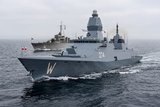
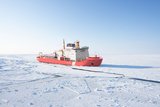
The Norwegian Coast Guard now has a full set of modern OPVs. (Photo: Royal Norwegian Navy)
The KV Hopen rounds out the Norwegian Coast Guard’s complement of offshore patrol vessels, replacing the Nordkapp class.


The Norwegian Coast Guard has taken command of the KV Hopen, the third Jan Mayen-class offshore patrol vessel (OPV) in its intended replacement for its Nordkapp class vessels.
The Jan Mayen-class vessels have ice-strengthened hulls and icebreaking capabilities, making them especially suitable for operations in Arctic conditions. The vessels are a significant upgrade on their predecessors, which were built back in the 1980s. The Jan Mayen-class vessels displace almost 9,800 tons apiece and are capable of spending up to 60 days at sea with 100 crewmembers between resupply runs.
Following KV Bjørnøya and KV Jan Mayen into service, KV Hopen will bolster the Norwegian Coast Guard’s new capabilities. It will be able to host one AW101 helicopter or two NH90 helicopters. The vessel is fitted with a 57mm Bofors gun and machine guns, meaning it can perform both defence and law enforcement missions as required by the situations it encounters.
Related Articles
Second Jan Mayen-class OPV handed over to Norway
The assignment of the KV Hopen came just days before the Norwegian and Canadian Coast Guards signed a letter of intent to cooperate more on a wide range of issues, particularly centred on the Arctic.
“Our collaboration with the Canadian Coast Guard will bring new opportunities for innovation and knowledge sharing,” explained Commodore Øyvind Dunsæd, commander of the Norwegian Coast Guard. “Our ongoing collaboration has already yielded significant benefits, and this new agreement will further enhance our joint efforts in critical areas such as decarbonisation and Arctic research.”
The collaboration agreement will extend to areas like advancing marine safety and environmental protection, formalising joint efforts in data analysis, education and training, decarbonisation, and Arctic scientific research, as well as developing enhanced capabilities in marine security.
This is not the first time the two Coast Guards have collaborated in the spirit of facing similar issues given their similar area of operation.
Mario Pelletier, commissioner of the Canadian Coast Guard, echoed his Norwegian counterpart, saying: “By working closely together, we can enhance our capabilities in marine security and address shared challenges more effectively.”
Related Programmes in Defence Insight
Jan Mayen Class (1-3) [Norway]
Related Equipment in Defence Insight

More from Naval Warfare
-
![US Navy’s MQ-25 Stingray approaches carrier-integration tests]()
US Navy’s MQ-25 Stingray approaches carrier-integration tests
Boeing has outlined its upcoming precision-landing and carrier-airspace trials as MQ-25 manufacturing shifts towards Illinois, with initial Lot 1 deliveries expected in 2029.
-
![From Poland to the Pacific: can Miecznik become a blueprint for other navies?]()
From Poland to the Pacific: can Miecznik become a blueprint for other navies?
Babcock is taking its Polish industrial partnership approach to Denmark and New Zealand as navies seek sovereign shipbuilding skills alongside ships.
-
![Unsettled waters in the North: can navies still trust their Arctic acoustic maps?]()
Unsettled waters in the North: can navies still trust their Arctic acoustic maps?
The changing Arctic environment is creating new challenges for submarine detection, driving demand for distributed sensors, uncrewed underwater vehicles and real-time acoustic modelling.