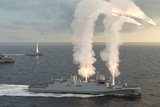
Northrop bridge systems for Thai navy
The Royal Thai Navy’s future frigates will be fitted with Northrop Grumman Sperry Marine’s full Integrated Bridge Systems (IBS) the company announced on 15 September.
The company has been issued a contract to supply a full IBS system to the navy through the Daewoo Shipbuilding and Marine Engineering shipyard, with options for three additional systems. The company is expected to deliver the system in June 2016.
The IBS incorporates the VisionMaster FT family of products and navigation systems, including the Voyage Data Recorder (VDR), Warship Automatic Identification System, NAVIKNOT speed log, and NAVIGAT X MK1 gyrocompass.
Additionally, the company has also been selected to supply X and S-band radars, a VisionMaster FT Electronic Chart Display and Information System, a speed log and gyrocompass systems to the Royal Thai Navy’s patrol boat currently under construction.
Jeanne Usher, managing director, Northrop Grumman Sperry Marine, said: ‘These latest orders validate the outstanding relationship built over many years between Sperry Marine and the Royal Thai Navy. Our Warship Electronic Chart Display and Information System (WECDIS) is designed to support the operational requirements of the modern navy and provide navigation teams with an integrated electronic navigation picture. This reduces navigator workload and improves situational and tactical awareness for the ship’s crew.’



You may also like
More from Naval Warfare
-
![Quantum Systems enters maritime domain with Baltic-focused USV and UUV]()
Quantum Systems enters maritime domain with Baltic-focused USV and UUV
Quantum Systems has launched into the maritime domain with Seavex and Subvex, aiming to close a Baltic Sea ISR gap opened by infrastructure sabotage.
-
![China’s mineral processing dominance exposes naval supply chain vulnerabilities]()
China’s mineral processing dominance exposes naval supply chain vulnerabilities
Competition for critical minerals, and China’s dominance of their processing, is emerging as a decisive factor in future naval procurement programmes.
-
![Suppliers await next step in Australia’s mine warfare transition]()
Suppliers await next step in Australia’s mine warfare transition
Australia’s mine countermeasure capability remains in flux as the Huon-class nears retirement, but accelerated investment in autonomous systems is opening a path for industry.
-
![Can the US Navy ask Indo-Pacific allies to do more while training with them less?]()
Can the US Navy ask Indo-Pacific allies to do more while training with them less?
As the Iran War draws US ships and marine corps units away from the Indo-Pacific, curtailed exercises and a temporary carrier gap are exposing tensions between Washington’s demand for more self-reliant allies and the joint training needed to realise that ambition.
-
![How could Rheinmetall’s GMF 140 fit with ongoing programmes in North America?]()
How could Rheinmetall’s GMF 140 fit with ongoing programmes in North America?
With Canada committed to its River-class replacement and the USN pursuing a lower-cost frigate, Rheinmetall will need to demonstrate where the GMF 140 can fill a capability gap in the North American fleet.
-
![Australian industry programme builds pipeline for Virginia-class sustainment]()
Australian industry programme builds pipeline for Virginia-class sustainment
Australian businesses can now bid to support Virginia-class submarine sustainment in Western Australia, as momentum around the Henderson Defence Precinct also builds.