South Korea launches its first missile-capable submarine
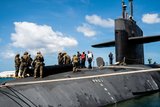
South Korea launched its first ever missile-capable attack submarine on 14 September, despite a recent diplomatic thaw with the nuclear-armed North.
The $700 million, 3,000t Dosan Ahn Chang-ho submarine is capable of firing both cruise and ballistic missiles, and it is the first of three planned diesel-electric boats to go into service in the next five years.
It represented a ‘leap forward in the country’s’ defence industry, South Korean President Moon Jae-in told the audience at a launch ceremony at the Daewoo shipyard where it was designed and built.
Moon will head to Pyongyang in the week of 17 September for a third summit with the North’s leader Kim Jong-un, as US-led efforts to persuade Pyongyang to give up its nuclear weapons have stalled.
Moon said: ‘We have set off on a grand journey toward the denuclearisation of the Korean peninsula. But peace is not given gratuitously. Peace through power is the unwavering security strategy of this government.’
The new submarine is fitted with six vertical-launch tubes and features indigenous sonar and combat management systems.
Aside from the new vessels, South Korea has an existing fleet of 18 smaller submarines, all built in cooperation with Germany.
According to the defence ministry, the North has 70 ageing submarines and submersibles, and Yonhap news agency reported that it has also developed a new 2,500t submarine fitted with a vertical-launch system.



More from Naval Warfare
-
![US turns to allies to tackle navy shipbuilding backlog]()
US turns to allies to tackle navy shipbuilding backlog
A White House memorandum acknowledges US Navy shipbuilding backlogs and a weakened industrial base, opening a formal path for South Korean and Japanese yards to help rebuild capacity.
-
![US Navy’s $275 billion BBGN plan hinges on shipyard transformation]()
US Navy’s $275 billion BBGN plan hinges on shipyard transformation
The US Navy’s planned nuclear-powered warship carries a US$275 billion price tag, but the greater story lies in the industrial overhaul needed to build it, from AI-enabled design to digital twins and modular construction.
-
![Industry sees opportunity in Australia’s shift to networked undersea warfare]()
Industry sees opportunity in Australia’s shift to networked undersea warfare
Australia’s new defence innovation strategy indicates a shift from platform-centric to network-centric undersea warfare, with Ocius and Anduril Industries pointing to fast-growing opportunities for local industry.
-
![Asia-Pacific emerges as the largest export market for US-made USVs]()
Asia-Pacific emerges as the largest export market for US-made USVs
Asian customers have placed one of the largest known international purchases of US-built uncrewed surface vessels, highlighting accelerating regional demand for autonomous maritime capabilities and distributed naval operations.