South African Navy to receive three IPVs


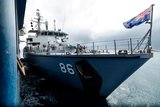
Damen Shipyards Cape Town (DSCT) has received an order to supply three inshore patrol vessels (IPV) for the South African Navy’s Project Biro, the company announced on 26 February.
The contract was awarded by Armscor, the acquisition agency for the South African Department of Defence.
Project Biro intends to enhance South Africa’s maritime security, ensuring that the country has the capability to respond effectively, rapidly and cost-efficiently to maritime threats such as illegal trafficking and fishing.
The 62x11 metre IPVs will be the first vessels of a Damen Sea Axe hull design to operate in South Africa. The vessel’s hull is a straight-edged, axe-shaped bow that cuts through the water, minimising slamming for improved safety and comfort on board and significantly reduced fuel consumption and emissions.

You may also like

More from Naval Warfare
-
![Competitive P17B tender marks a shift in Indian Navy frigate procurement]()
Competitive P17B tender marks a shift in Indian Navy frigate procurement
The Indian Navy's P17B programme is expected to combine greater weapons capacity with a competitive domestic construction model, although key systems could remain dependent on international supply chains.
-
![How France’s SNLE 3G programme is reshaping the naval nuclear industrial base]()
How France’s SNLE 3G programme is reshaping the naval nuclear industrial base
Extending far beyond a four-submarine replacement programme, France’s ballistic missile submarine effort is a decades-long industrial initiative designed to preserve the country’s ability to build and sustain nuclear-powered strategic platforms.
-
![China’s mineral processing dominance exposes naval supply chain vulnerabilities]()
China’s mineral processing dominance exposes naval supply chain vulnerabilities
Competition for critical minerals, and China’s dominance of their processing, is emerging as a decisive factor in future naval procurement programmes.
-
![Suppliers await next step in Australia’s mine warfare transition]()
Suppliers await next step in Australia’s mine warfare transition
Australia’s mine countermeasure capability remains in flux as the Huon-class nears retirement, but accelerated investment in autonomous systems is opening a path for industry.
-
![Can the US Navy ask Indo-Pacific allies to do more while training with them less?]()
Can the US Navy ask Indo-Pacific allies to do more while training with them less?
As the Iran War draws US ships and marine corps units away from the Indo-Pacific, curtailed exercises and a temporary carrier gap are exposing tensions between Washington’s demand for more self-reliant allies and the joint training needed to realise that ambition.