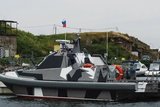
Second patrol vessel for Bulgaria enters production
A rendering of the Bulgarian MMPV based on the OPV-90 design. (Image: NVL Group)
The steel-cutting marks a traditional milestone in the building of a new ship.


Last week, NVL Group and its local partner MTG Dolphin began production of the second modular multipurpose patrol vessel (MMPV) for the Bulgarian Navy.
NVL Group is managing the production of two MMPVs for Bulgaria at the MTG Dolphin yard in Varna.
The first vessel is scheduled for delivery in Q3 of 2025, and the second will follow a year later, in 2026.
Related Articles
Keel laid for first Bulgarian Navy MMPV at MTG Dolphin
Bulgarian Navy Commander RAdm Kiril Mihaylov said: ‘This ship will give the opportunity to Bulgarian naval sailors to fulfil all tasks for defending national maritime interests and to successfully participate in allied operations and missions.‘
Based on the Lürssen OPV-90 design, the two vessels under the project will measure 90m long and displace 2,300t.
Shephard Defence Insight estimates the cost of each ship to be $236.5 million.
The MMPVs will replace obsolescent ex-Soviet vessels, including two Pauk II-class (Project 1241PE) anti-submarine corvettes and one Tarantul III-class (Project 1241.1M) corvette.
Related Programmes in Defence Insight
Multipurpose Modular Patrol Vessels (MMPV) (1-2) [Bulgaria]
Related Equipment in Defence Insight

More from Naval Warfare
-
![Australian industry programme builds pipeline for Virginia-class sustainment]()
Australian industry programme builds pipeline for Virginia-class sustainment
Australian businesses can now bid to support Virginia-class submarine sustainment in Western Australia, as momentum around the Henderson Defence Precinct also builds.
-
![Japan’s FY2027 budget bets on stand-off systems to offset demographic decline]()
Japan’s FY2027 budget bets on stand-off systems to offset demographic decline
Japan’s FY2027 defence budget backs stand-off strike, a 17-aircraft MQ-9B buy and a declared bid to lead the world in uncrewed maritime assets, alongside new frigates, submarines and support ships.
-
![Russia’s uncrewed boat portfolio hints at future naval demand]()
Russia’s uncrewed boat portfolio hints at future naval demand
Ukrainian intelligence has catalogued more than 20 Russian uncrewed surface vessels, revealing a portfolio weighted towards mine warfare and logistics, with implications for Western naval investment.