Russia’s uncrewed boat portfolio hints at future naval demand
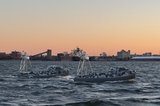
Russia’s Iskatel uncrewed surface vessel is designed for monitoring, hydrographic survey and infrastructure inspection. (Photo: Defence Intelligence of Ukraine)
Ukrainian intelligence has catalogued more than 20 Russian uncrewed surface vessels, revealing a portfolio weighted towards mine warfare and logistics, with implications for Western naval investment.


Ukraine’s Defence Intelligence directorate published a detailed breakdown of Russia’s uncrewed surface vessel (USV) programmes on 25 August 2026. It catalogues more than 20 platforms domestically designated “BEK” (bezekipazhny kater, or crewless boat). The release offers an open-source picture of where Moscow may be directing its uncrewed maritime investment.
Only a small minority of the platforms identified, among them a wooden kamikaze boat and the small “Marlin” and “Vodyanoy” designs, appear purpose-built for one-way attack missions. According to the catalogue, the bulk of the portfolio instead clusters around reconnaissance, hydrographic survey, mine countermeasures, logistics and radio relay.
The Iskatel, unveiled in 2017
Our news & analysis is now part of Defence Insight®
A Basic-level or higher Defence Insight subscription is now required to view this content.

More from Naval Warfare
-
![US Navy’s MQ-25 Stingray approaches carrier-integration tests]()
US Navy’s MQ-25 Stingray approaches carrier-integration tests
Boeing has outlined its upcoming precision-landing and carrier-airspace trials as MQ-25 manufacturing shifts towards Illinois, with initial Lot 1 deliveries expected in 2029.
-
![From Poland to the Pacific: Can Miecznik become a blueprint for other navies?]()
From Poland to the Pacific: Can Miecznik become a blueprint for other navies?
Babcock is taking its Polish industrial partnership approach to Denmark and New Zealand as navies seek sovereign shipbuilding skills alongside ships.
-
![Aevex, Lockheed Martin and Thales deals highlight consolidation in naval technology]()
Aevex, Lockheed Martin and Thales deals highlight consolidation in naval technology
A wave of acquisitions is bringing specialist autonomy and underwater technology under the umbrella of larger defence contractors. As a result, navies may gain faster access to capability, but not necessarily a broader choice of suppliers.
-
![Italy’s DDX destroyer deal opens a decade of naval spending]()
Italy’s DDX destroyer deal opens a decade of naval spending
A €3.7 billion destroyer contract for Fincantieri and Leonardo is only the start, with submarines, corvettes and a new carrier pointing to more opportunities.