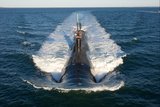
Russia moves to enhance maritime security


The Russian government is considering a set of measures to enhance the level of security in its ports, amid the ever-deteriorating geopolitical environment and the threat of a military conflict with Ukraine.
Despite the size of country’s sea coast – currently estimated at 38,800 km, which is by 2.5 times more its land border – and the importance of seaports to Russia’s imports, there has been little focus on issues of security in recent years.
However, the Russian parliament is now looking at new measures aimed at strengthening the country’s maritime security and recently approved a number of new amendments
Our news & analysis is now part of Defence Insight®
A Basic-level or higher Defence Insight subscription is now required to view this content.


More from Naval Warfare
-
![RTX confirms US Marine Corps and US Navy acquire Hadalus UUV]()
RTX confirms US Marine Corps and US Navy acquire Hadalus UUV
RTX told Shephard that the Hadalus UUV has been procured by the US Marine Corps and the Office of Naval Research for operational experimentation as the company prepares additional demonstrations with the US Navy, NATO and AUKUS partners.
-
![Europe’s naval contractors benefit from growing refit and upgrade demand]()
Europe’s naval contractors benefit from growing refit and upgrade demand
Rheinmetall’s order to modernise the German Navy frigate Bayern points to a wider European shift towards extending warship service life as new-build programmes face delay.
-
![The UK joins the movement towards joint procurement]()
The UK joins the movement towards joint procurement
The UK will spend an estimated US$3.89 billion over the next decade in joint naval programmes, a lot of which will be in cooperation with Norway.
-
![Rheinmetall’s GMF 140: Ambitious frigate or market misfit?]()
Rheinmetall’s GMF 140: Ambitious frigate or market misfit?
Rheinmetall has unveiled its first next-generation frigate design, showing ambitions to compete as a surface combatant prime contractor. While the company is targeting North America, analysts believe the concept may be better positioned for future European programmes.
-
![US Navy $76.6bn award provides stability for submarine production]()
US Navy $76.6bn award provides stability for submarine production
The US Department of War’s US$76.6 billion Columbia-and Virginia-class submarine contract gives industry demand certainty as Washington seeks to rebuild its shipbuilding base.
-
![Dreadnought Phase 4 opens £2.5 billion supply chain opportunity]()
Dreadnought Phase 4 opens £2.5 billion supply chain opportunity
The UK government’s £8.4 billion Dreadnought Phase 4 investment sets aside £2.5 billion for the wider submarine supply chain, opening new work beyond BAE Systems’ prime contract.