Royal Navy christens HMS Tamar


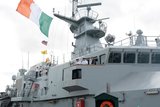
The Royal Navy has officially named its fourth Batch 2 River-class offshore patrol vessel (OPV) HMS Tamar.
Designed for counter-terrorism and anti-smuggling operations, the 90m OPV is equipped with a 30mm cannon and a flight deck capable of accommodating a Merlin helicopter. The vessel is part of a five-strong OPV fleet being built for the navy under a contract with BAE Systems worth a combined £635 million.
All the Batch 2 OPVs, named HMS Forth, HMS Medway, HMS Trent, HMS Tamar, and HMS Spey, are set to be delivered to the Royal Navy by the end of 2020.
The vessels are constructed in BAE System’s Govan yard, before being moved to its Scotstoun site to be fitted out with their systems ahead of rigorous sea trials.
Stuart Andrew, UK’s Minister for Defence Procurement, said: ‘From patrolling our coastlines and protecting UK waters, to anti-smuggling and counter terrorism operations, these ships are a key part of our Royal Navy fleet. Today’s naming marks an important milestone in HMS Tamar’s programme ahead of starting sea trials and being accepted into operational service next year.’
Related Equipment in Defence Insight


More from Naval Warfare
-
![US turns to allies to tackle navy shipbuilding backlog]()
US turns to allies to tackle navy shipbuilding backlog
A White House memorandum acknowledges US Navy shipbuilding backlogs and a weakened industrial base, opening a formal path for South Korean and Japanese yards to help rebuild capacity.
-
![US Navy’s $275 billion BBGN plan hinges on shipyard transformation]()
US Navy’s $275 billion BBGN plan hinges on shipyard transformation
The US Navy’s planned nuclear-powered warship carries a US$275 billion price tag, but the greater story lies in the industrial overhaul needed to build it, from AI-enabled design to digital twins and modular construction.
-
![RTX confirms US Marine Corps and US Navy acquire Hadalus UUV]()
RTX confirms US Marine Corps and US Navy acquire Hadalus UUV
RTX told Shephard that the Hadalus UUV has been procured by the US Marine Corps and the Office of Naval Research for operational experimentation as the company prepares additional demonstrations with the US Navy, NATO and AUKUS partners.