South Korean navy orders four more Geomdoksuri Batch-II patrol vessels
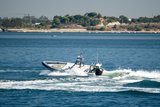
Hanjin has long experience in building ROK Navy patrol vessels. (Photo: Hanjin Heavy Industries)
The contract follows on from previous work by Hanjin Heavy Industries on the Republic of Korea’s Navy’s (ROKN’s) fleet.


The Republic of Korea Navy (ROKN) has chosen a shipbuilder for the high-speed patrol boats that will replace its Chamsuri-class vessels.
Hanjin Heavy Industries has been awarded the contract to build four Geomdoksuri-B Batch-II vessels at a cost of KRW266.3 billion (US$179 million).
South Korea’s Defense Acquisition Program Administration (DAPA) has reason to be confident of Hanjin’s ability to deliver the four new vessels. The South Korean shipbuilder previously built all 16 Geomdoksuri-B Batch I vessels, and was chosen to build the first eight vessels in the Batch-II cohort, a contract it agreed late in 2024.
During 2024, Hanjin also won a number of other orders from the DAPA, including for the construction of a coast guard patrol vessel, while delivering performance upgrades to 18 ROKN fast attack craft, and depot maintenance projects for the ROKN’s oldest amphibious vessel, the ROKS Dokdo.
The four new vessels will build on that history as Geomdoksuri-B Batch II, hulls 9-13.
The new vessels will feature updated combat capabilities, as well as anti-missile decoy systems. Like their predecessors in the fleet, the Geomdoksuri-B Batch II patrol vessels will be deployed on coastal defence missions, with particular responsibility to safeguard the country’s Northern Limit Line.
The ROKN has recently also secured US State Department agreement to help modernise its KDX-II-class destroyer programme. The agreement, in the form of a Foreign Military Sale equivalent to $300 million, will update fire control systems and weapon system software for the destroyers, to maintain their operating viability without directly advancing their capabilities.
Related Programmes in Defence Insight
PKX-B Batch II (13-22) [South Korea]
Related Equipment in Defence Insight


More from Naval Warfare
-
![From REPMUS to procurement: the four capabilities NATO navies want from USVs]()
From REPMUS to procurement: the four capabilities NATO navies want from USVs
Syos Aerospace will channel its first outside capital into research, production and overseas reach as navies seek jam-resistant, integrated uncrewed fleets.
-
![Canada targets 2027 frigate trials for CU179 Peregrine uncrewed helicopter]()
Canada targets 2027 frigate trials for CU179 Peregrine uncrewed helicopter
The Royal Canadian Navy’s CU179 Peregrine will undergo Halifax-class frigate trials in 2027 ahead of initial operational capability in 2028, while River-class destroyer integration arrangements remain undefined.
-
![AUKUS heavyweight torpedo test raises questions over future armed UUV requirements]()
AUKUS heavyweight torpedo test raises questions over future armed UUV requirements
A heavyweight torpedo firing from the Royal Navy’s uncrewed submarine XV Excalibur suggests a shift beyond surveillance, with allied navies eyeing strike roles for large autonomous undersea vessels.
-
![Industrial teams prepare roadmap for Indonesia aircraft carrier transformation]()
Industrial teams prepare roadmap for Indonesia aircraft carrier transformation
Fincantieri and PT PAL have agreed on a framework to modernise the former Giuseppe Garibaldi, with drones, communications and broader Italian–Indonesian industrial ties involved.