Rheinmetall celebrates 300 delivered MASS systems
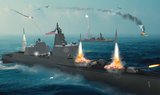
The automatic decoy system MASS. (Photo: Rheinmetall)
Rheinmetall is celebrating the 300th delivery of its MASS naval countermeasures system.


Rheinmetall has crossed a benchmark in the field of maritime protection systems. The company has delivered 300 Multi Ammunition Softkill Systems (MASS). The 300th delivery was for the Finnish Navy.
MASS was launch onto the market in 2002 and is today in service with no fewer than 14 user nations.
Rheinmetall’s MASS family of ship protection systems is suitable for use by blue, green and brown water navies. It offers protection to vessels against a wide range of threats, in the open ocean, littoral and river environments.
The MASS decoy system is fully automated and offers protection against modern, sensor-guided missiles, covering all relevant wavelengths of the electromagnetic spectrum.
MASS can be installed on any type of vessel and can be integrated into an existing combat management system or operate as a standalone system.
The majority of MASS consists of between one and six trainable launchers. Each launcher can fire 32 Omni Trap special effect charges and comes with a control unit and a data interface.
According to Shephard Defence Insight, the countermeasures initiated by the system generate a decoy target, which the incoming missile interprets to be a higher-value asset, causing the projectile to stray off course.
As part of our promise to deliver comprehensive coverage to our Defence Insight and Premium News subscribers, our curated defence news content provides the latest industry updates, contract awards and programme milestones.
Related Equipment in Defence Insight



More from Naval Warfare
-
![US turns to allies to tackle navy shipbuilding backlog]()
US turns to allies to tackle navy shipbuilding backlog
A White House memorandum acknowledges US Navy shipbuilding backlogs and a weakened industrial base, opening a formal path for South Korean and Japanese yards to help rebuild capacity.
-
![US Navy’s $275 billion BBGN plan hinges on shipyard transformation]()
US Navy’s $275 billion BBGN plan hinges on shipyard transformation
The US Navy’s planned nuclear-powered warship carries a US$275 billion price tag, but the greater story lies in the industrial overhaul needed to build it, from AI-enabled design to digital twins and modular construction.
-
![Industry sees opportunity in Australia’s shift to networked undersea warfare]()
Industry sees opportunity in Australia’s shift to networked undersea warfare
Australia’s new defence innovation strategy indicates a shift from platform-centric to network-centric undersea warfare, with Ocius and Anduril Industries pointing to fast-growing opportunities for local industry.
-
![Asia-Pacific emerges as the largest export market for US-made USVs]()
Asia-Pacific emerges as the largest export market for US-made USVs
Asian customers have placed one of the largest known international purchases of US-built uncrewed surface vessels, highlighting accelerating regional demand for autonomous maritime capabilities and distributed naval operations.