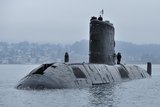
RCN submarines to receive new tactical navigation system


OSI Maritime Systems is to provide its Tactical Dived Navigation System (TDNS) to the Royal Canadian Navy (RCN) as part of a fleet-wide submarine upgrade programme.
TDNS is fully qualified to military specifications, OSI announced on 6 August. The system for the RCN will include a Digital Maritime Operations Plot (D-MOP) flatscreen display and ECPINS Submarine.
‘Combined, the two solutions provide a state-of-the-art tactical navigation advantage,’ OSI claimed.
D-MOP hardware and system architecture is custom-fitted to enhance crew navigational and tactical efficiencies, it added, while ECPINS Submarine exploits technology by offering features that increase the subsurface performance by being able to operate with or without the aid of sensors.
In common with other OSI solutions, deployed on submarines operated by nine navies, TDNS complies with the NATO STANAG 4564 standard for warship electonic chart display information systems.
The four submarines in the RCN fleet (HMCS Victoria, HMCS Windsor, HMCS Chicoutimi and HMCS Corner Brook) have struggled for operational availability for some years. They were dry-docked in 2019 for long-term upgrades to ensure they remain operational until the late 2020s.
As part of our promise to deliver comprehensive coverage to our Defence Insight and Premium News subscribers, our curated defence news content provides the latest industry updates, contract awards and programme milestones.
Related Equipment in Defence Insight




More from Naval Warfare
-
![A400M trial demonstrates airborne deployment of uncrewed surface vessel]()
A400M trial demonstrates airborne deployment of uncrewed surface vessel
Kraken Technology Group’s A400M airdrop of a K3 Scout uncrewed surface vessel points to a new way for navies to insert USVs into contested waters, bypassing ports and motherships.
-
![Babcock onshores 85% of Canada’s submarine supply chain as it eyes future CPSP programme]()
Babcock onshores 85% of Canada’s submarine supply chain as it eyes future CPSP programme
By moving most of the Royal Canadian Navy’s submarine supply chain into Canada, Babcock Canada is driving to strengthen sovereign sustainment capabilities while preparing to compete to maintain the future Canadian Patrol Submarine Project.
-
![From the seas to the web: the changing shape of UK defence in Southeast Asia]()
From the seas to the web: the changing shape of UK defence in Southeast Asia
As his final engagement before leaving his post as the head of the British defence staff for Southeast Asia and defence adviser to Singapore, Brigadier Eddie Maskell-Pedersen spoke with Shephard about maritime security, cyber cooperation and long-term partnerships.
-
![Baltic naval priorities shift towards mine warfare and versatile platforms]()
Baltic naval priorities shift towards mine warfare and versatile platforms
Baltic states are investing in mine warfare, uncrewed systems and multirole platforms as major warship purchases remain scarce, industry sources indicate.