RAN ASMD programme progresses


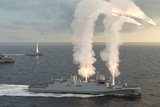
On-dock production activities as part of HMAS Ballarat’s Anti-Ship Missile Defence (ASMD) upgrade are now complete, and the vessel has returned to the Material Control of the Royal Australian Navy (RAN).
The vessel was undocked on 2 September at BAE Systems Henderson (WA) shipyard after 56 weeks on the hardstand as part of the ASMD upgrade and vital maintenance work.
The ASMD programme includes the upgrade of the vessel’s combat management system and the introduction of an infrared search and track system, a phased array radar and dual navigation radar system.
While the ships are on the hard stand for the ASMD upgrade, other complex engineering and structural changes are being made to the frigates, including enclosing the quarterdeck and modifications to accommodate the MH-60 Romeo naval helicopters.
Ballarat will now be berthed at Henderson to conduct systems set to works and harbour trials. The BAE Systems Henderson facility will continue to focus on the ASMD upgrade programme, with work on HMAS Parramatta, and preparations to dock HMAS Toowoomba continuing.
The work was completed through the Anzac Ship Integrated Material Support Program Alliance comprising BAE Systems, Saab Systems and the Department of Defence Capability Acquisition and Sustainment Group (CASG). The programme is on-track to be completed in 2017 and will include upgrades to a further three vessels, including HMAS Parramatta, Toowoomba and Stuart.
Related Equipment in Defence Insight

You may also like

More from Naval Warfare
-
![How France’s SNLE 3G programme is reshaping the naval nuclear industrial base]()
How France’s SNLE 3G programme is reshaping the naval nuclear industrial base
Extending far beyond a four-submarine replacement programme, France’s ballistic missile submarine effort is a decades-long industrial initiative designed to preserve the country’s ability to build and sustain nuclear-powered strategic platforms.
-
![China’s mineral processing dominance exposes naval supply chain vulnerabilities]()
China’s mineral processing dominance exposes naval supply chain vulnerabilities
Competition for critical minerals, and China’s dominance of their processing, is emerging as a decisive factor in future naval procurement programmes.
-
![Suppliers await next step in Australia’s mine warfare transition]()
Suppliers await next step in Australia’s mine warfare transition
Australia’s mine countermeasure capability remains in flux as the Huon-class nears retirement, but accelerated investment in autonomous systems is opening a path for industry.
-
![Can the US Navy ask Indo-Pacific allies to do more while training with them less?]()
Can the US Navy ask Indo-Pacific allies to do more while training with them less?
As the Iran War draws US ships and marine corps units away from the Indo-Pacific, curtailed exercises and a temporary carrier gap are exposing tensions between Washington’s demand for more self-reliant allies and the joint training needed to realise that ambition.
-
![How could Rheinmetall’s GMF 140 fit with ongoing programmes in North America?]()
How could Rheinmetall’s GMF 140 fit with ongoing programmes in North America?
With Canada committed to its River-class replacement and the USN pursuing a lower-cost frigate, Rheinmetall will need to demonstrate where the GMF 140 can fill a capability gap in the North American fleet.