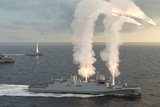
BAE Systems wins RAN ANZAC ASMD contract


The Australian Department of Defence has selected BAE Systems to carry out an upgrade of the seven remaining Royal Australian Navy ANZAC class frigates, with the Anti-Ship Missile Defence (ASMD) capability already implemented on the first of class, HMAS Perth.
The contract, worth AUD $270 million, will be completed through the ANZAC Ship Integrated Material Support Program Alliance comprising BAE Systems, Saab Systems and the Defence Materiel Organisation (DMO).
The contract follows the end of a comprehensive testing programme carried out on HMAS Perth for the ASMD programme. According to the Australian government, the weapon will bring a new level of capabilities to the fleet. Rather than be able to track and destroy one target at a time, the new system is able to identify, track and guide missiles to multiple targets at the same time.
The upgrade will include ship integration of the leading edge CEA Phased Array Radar (PAR), the Vampir NG Infrared Search & Track (IRST) system, the Sharpeye Navigation Radar System (NRS), and an upgraded Saab Combat Management System (CMS) including an improved operations room layout.
According to BAE Systems, project management and planning for ship two will begin immediately with fabrication set to begin early June next year and installation to commence in the fourth quarter of 2012.




More from Naval Warfare
-
![How France’s SNLE 3G programme is reshaping the naval nuclear industrial base]()
How France’s SNLE 3G programme is reshaping the naval nuclear industrial base
Extending far beyond a four-submarine replacement programme, France’s ballistic missile submarine effort is a decades-long industrial initiative designed to preserve the country’s ability to build and sustain nuclear-powered strategic platforms.
-
![Quantum Systems enters maritime domain with Baltic-focused USV and UUV]()
Quantum Systems enters maritime domain with Baltic-focused USV and UUV
Quantum Systems has launched into the maritime domain with Seavex and Subvex, aiming to close a Baltic Sea ISR gap opened by infrastructure sabotage.
-
![China’s mineral processing dominance exposes naval supply chain vulnerabilities]()
China’s mineral processing dominance exposes naval supply chain vulnerabilities
Competition for critical minerals, and China’s dominance of their processing, is emerging as a decisive factor in future naval procurement programmes.
-
![Suppliers await next step in Australia’s mine warfare transition]()
Suppliers await next step in Australia’s mine warfare transition
Australia’s mine countermeasure capability remains in flux as the Huon-class nears retirement, but accelerated investment in autonomous systems is opening a path for industry.
-
![Can the US Navy ask Indo-Pacific allies to do more while training with them less?]()
Can the US Navy ask Indo-Pacific allies to do more while training with them less?
As the Iran War draws US ships and marine corps units away from the Indo-Pacific, curtailed exercises and a temporary carrier gap are exposing tensions between Washington’s demand for more self-reliant allies and the joint training needed to realise that ambition.
-
![How could Rheinmetall’s GMF 140 fit with ongoing programmes in North America?]()
How could Rheinmetall’s GMF 140 fit with ongoing programmes in North America?
With Canada committed to its River-class replacement and the USN pursuing a lower-cost frigate, Rheinmetall will need to demonstrate where the GMF 140 can fill a capability gap in the North American fleet.