Pakistan Navy has designs on Jinnah-class frigates
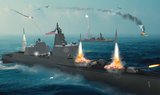
The possible design of the Jinnah-class frigate was showcased by ASFAT at IDEF 2021. (Tayfun Ozberk)
Pakistan is on to a good thing with Turkey as it gains experience in warship design and construction, moving from the Babur class towards the Jinnah class.


The Pakistan Navy (PN) will build six Jinnah-class frigates with Turkish assistance. On 21 April, SSI announced that its ShipConstructor software had been selected for the engineering and detailed design solution of this new class.
SSI was awarded this contract from Turkey’s state-owned ASFAT, part of the Ministry of National Defense. ASFAT is providing design support to Pakistan throughout the process.
Darren Larkins, co-CEO of SSI, said: ‘ASFAT has previously demonstrated its commitment to innovative technologies. By choosing SSI’s solution, they can take advantage of the latest innovations, reduce costs and eliminate many of the typical change management risks
Our news & analysis is now part of Defence Insight®
A Basic-level or higher Defence Insight subscription is now required to view this content.


You may also like
More from Naval Warfare
-
![US Navy’s $275 billion BBGN plan hinges on shipyard transformation]()
US Navy’s $275 billion BBGN plan hinges on shipyard transformation
The US Navy’s planned nuclear-powered warship carries a US$275 billion price tag, but the greater story lies in the industrial overhaul needed to build it, from AI-enabled design to digital twins and modular construction.
-
![Industry sees opportunity in Australia’s shift to networked undersea warfare]()
Industry sees opportunity in Australia’s shift to networked undersea warfare
Australia’s new defence innovation strategy indicates a shift from platform-centric to network-centric undersea warfare, with Ocius and Anduril Industries pointing to fast-growing opportunities for local industry.
-
![Asia-Pacific emerges as the largest export market for US-made USVs]()
Asia-Pacific emerges as the largest export market for US-made USVs
Asian customers have placed one of the largest known international purchases of US-built uncrewed surface vessels, highlighting accelerating regional demand for autonomous maritime capabilities and distributed naval operations.
-
![RTX confirms US Marine Corps and US Navy acquire Hadalus UUV]()
RTX confirms US Marine Corps and US Navy acquire Hadalus UUV
RTX told Shephard that the Hadalus UUV has been procured by the US Marine Corps and the Office of Naval Research for operational experimentation as the company prepares additional demonstrations with the US Navy, NATO and AUKUS partners.
-
![The UK joins the movement towards joint procurement]()
The UK joins the movement towards joint procurement
The UK will spend an estimated US$3.89 billion over the next decade in joint naval programmes, a lot of which will be in cooperation with Norway.