OSI sees benefits in cementing relationship with ARCHE in Germany
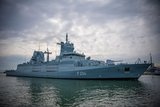
Braunschweig-class corvette Oldenburg, pictured in May 2022 firing an RBS-15 guided missile (Photo: Bundeswehr/Marcel Kröncke)
OSI hopes to seal an in-country service partnership with ARCHE for German naval programmes.


German company ARCHE Systeme is to receive training to become an in-country service partner for OSI Maritime Systems, the latter announced on 12 September.
OSI is providing the integrated bridge system for the four new F126 frigates ordered by the German Navy as a subcontractor to Damen, and it is also a subcontractor to ARCHE on a programme to upgrade the navigation system for K130 (Braunschweig-class) corvettes.
Ken Kirkpatrick, president and CEO of OSI, described ARCHE as ‘an ideal partner... to grow our footprint in Germany’.
ARCHE specialises in project management, hardware and software development and sensor integration of naval systems.

You may also like

More from Naval Warfare
-
![Australian industry programme builds pipeline for Virginia-class sustainment]()
Australian industry programme builds pipeline for Virginia-class sustainment
Australian businesses can now bid to support Virginia-class submarine sustainment in Western Australia, as momentum around the Henderson Defence Precinct also builds.
-
![South Korea, Japan and Turkey vie for US shipbuilding access in future frigate contest]()
South Korea, Japan and Turkey vie for US shipbuilding access in future frigate contest
Washington’s search for a foreign-built frigate could hand South Korea, Japan and Turkey a larger prize than a double-hull order: a foothold inside the US shipbuilding industrial base.
-
![Japan’s FY2027 budget bets on stand-off systems to offset demographic decline]()
Japan’s FY2027 budget bets on stand-off systems to offset demographic decline
Japan’s FY2027 defence budget backs stand-off strike, a 17-aircraft MQ-9B buy and a declared bid to lead the world in uncrewed maritime assets, alongside new frigates, submarines and support ships.
-
![Russia’s uncrewed boat portfolio hints at future naval demand]()
Russia’s uncrewed boat portfolio hints at future naval demand
Ukrainian intelligence has catalogued more than 20 Russian uncrewed surface vessels, revealing a portfolio weighted towards mine warfare and logistics, with implications for Western naval investment.
-
![Ukraine’s new long-range 12m autonomous vessel can deploy other drones]()
Ukraine’s new long-range 12m autonomous vessel can deploy other drones
Ukraine’s UForce unveiled the MV11 uncrewed surface vessel, designed to launch and support other naval drones at sea, fuelling debate over the future of autonomous maritime task groups.