Damen chooses Kongsberg Maritime as propeller supplier for German Navy F126 frigates
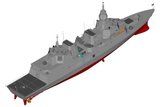
Rendering of F126 frigate. (Image: Kongsberg Maritime)
The F126 supply chain network gathers pace with the selection of Kongsberg Maritime Sweden to provide controllable-pitch propellers.


Kongsberg Maritime Sweden revealed on 1 September that it has received a contract from Damen Naval to supply controllable-pitch propellers and associated equipment for the four future German Navy F126 frigates.
The deal (worth an undisclosed amount) follows a June 2022 contract from Damen Naval for Renk to provide gearboxes and electric propulsion systems, as the supply chain for the F126 programme takes shape.
The F126 frigates will each include two propellers and shaft lines. ‘The propeller/shaft line system is the successful result of a close cooperation between Damen Naval, Kongsberg Maritime, HSVA test institute from Hamburg and the [German] classification society,’ Kongsberg Maritime Sweden noted in a statement.
The four F126 vessels will be delivered to the German Navy between 2028 and 2031. There is the option for two more ships after 2032 ‘with an extended scope of Kongsberg Maritime equipment’, the Swedish company added.
Kongsberg Maritime has often collaborated with Damen Naval on shipbuilding projects such as SIGMA frigates and the Royal Netherlands Navy support vessels HNLMS Karel Doorman and HNLMS Den Helder.
Related Programmes in Defence Insight
F126 programme (5-6) [Germany]
F126 programme (1-4) [Germany]
Related Equipment in Defence Insight



More from Naval Warfare
-
![Aevex, Lockheed Martin and Thales deals highlight consolidation in naval technology]()
Aevex, Lockheed Martin and Thales deals highlight consolidation in naval technology
A wave of acquisitions is bringing specialist autonomy and underwater technology under the umbrella of larger defence contractors. As a result, navies may gain faster access to capability, but not necessarily a broader choice of suppliers.
-
![Italy’s DDX destroyer deal opens a decade of naval spending]()
Italy’s DDX destroyer deal opens a decade of naval spending
A €3.7 billion destroyer contract for Fincantieri and Leonardo is only the start, with submarines, corvettes and a new carrier pointing to more opportunities.
-
![Production-ready beats prototype-ready in the US Navy’s MUSV marketplace]()
Production-ready beats prototype-ready in the US Navy’s MUSV marketplace
HII, Saronic and Galliano Marine Services have won US Navy production contracts to supply medium uncrewed surface vessels. The marketplace approach behind them sets the bar for suppliers eyeing allied navy competitions.