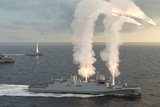
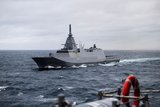
OCCAR orders seven vessels for Italian Navy
The Organisation for Joint Armament Cooperation (OCCAR) has signed an order for the construction of seven vessels for the Italian Navy with Fincantieri and Finmeccanica. Fincantieri announced the order on 7 May.
The order covers the construction of six multipurpose offshore patrol vessels (PPA), with four more in option; and one logistic support ship (LSS), as part of plans to renew the Italian Navy’s fleet.
The contract will be led by Fincantieri as agent, with Finmeccanica acting through its subsidiary Selex ES.
The value of the contracts for the seven units is approximately $3.96 billion, of which Fincantieri’s share amounts to approximately $2.6 billion and the one of Finmeccanica to about $1.36 billion.
The work will be conducted under a number of different phases. The first phase for the construction of the first patrol vessel and the logistic support ship has begun, and the activation of the next phases for the other units is expected to take place in the upcoming months.
The LSS will provide logistics support to the fleet, carrying diesel fuel, jet fuel, fresh water, emergency spare parts, food and ammunitions, an at-sea hospital, and will have the capacity to perform at sea repairs and maintenance work for other vessels.
The PPA is a highly flexible ship with the capacity to serve multiple functions ranging from patrol with sea rescue, to civil protection operations - and in its most highly equipped version, first line fighting vessel. The combat system will be capable of providing ‘soft’ defence for patrol tasks, and ‘full’ defence providing a complete defence ability.
The LSS is scheduled for delivery in 2019, and the first PPA is scheduled for 2021. The following PPAs are planned for delivery in 2022, 2023, 2024 (two units) and 2025.
Fincantieri will also provide support in the first ten years of the vessels’ lifespan, while Selex will act as prime contractor for all the new naval units’ combat systems, including a new multi-functional radar and other sensors; and will be responsible for subsystems procured from OTO Melara, WASS, MBDA and Elettronica.
Selex and Fincantieri will also develop the cockpit system, which will allow for the integrated management of sailing and combat system operations, using augmented reality to allow both functions to be effectively managed with fewer operators





More from Naval Warfare
-
![Can the US Navy ask Indo-Pacific allies to do more while training with them less?]()
Can the US Navy ask Indo-Pacific allies to do more while training with them less?
As the Iran War draws US ships and marine corps units away from the Indo-Pacific, curtailed exercises and a temporary carrier gap are exposing tensions between Washington’s demand for more self-reliant allies and the joint training needed to realise that ambition.
-
![How could Rheinmetall’s GMF 140 fit with ongoing programmes in North America?]()
How could Rheinmetall’s GMF 140 fit with ongoing programmes in North America?
With Canada committed to its River-class replacement and the USN pursuing a lower-cost frigate, Rheinmetall will need to demonstrate where the GMF 140 can fill a capability gap in the North American fleet.
-
![South Korea, Japan and Turkey vie for US shipbuilding access in future frigate contest]()
South Korea, Japan and Turkey vie for US shipbuilding access in future frigate contest
Washington’s search for a foreign-built frigate could hand South Korea, Japan and Turkey a larger prize than a double-hull order: a foothold inside the US shipbuilding industrial base.