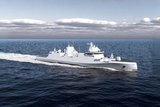
New Netherlands combat support ship Den Helder starts sea trials
The Den Helder beginning its sea trials. (Photo: Damen Shipyard)
The vessel is expected to provide a significant additional capacity in the fight against drug trafficking and other police actions.


The Royal Netherlands Navy (RNLN) combat support ship (CSS) Den Helder has begun sea trials.
Departing from the Damen Shipyards in Galati, Romania, the CSS crossed the Danube River before sailing in both the Black Sea and the Mediterranean Sea. The ship was built in Romania to keep costs lower than it would have been had it been constructed in the Netherlands.
At the end of its sea trials, the Den Helder will see the Netherlands for the first time to be equipped with its sensors and weapon systems in Vlissengen. It is scheduled to become operational in Q2 2025.
Related Articles
Dutch navy launches new rMCM vessel
When it comes into service, the Den Helder will be assigned to support the only other replenishment vessel in the RNLN, Joint Support Ship (JSS) HNLMS Karel Doorman. Both vessels will then be able to supply ammunition, food, fuel and other necessary replenishments to NATO allied vessels.
At almost 200m (656ft) Den Helder will also boost the RNLN’s capabilities in police actions, such as the prevention of drug trafficking, refugee flow control and emergency relief missions.
The vessel will have two replenishment at sea (RAS) stations, as well as a helicopter deck and hangar for flight operations. It is capable of accommodating multiple helicopters and around 20 ISO containers. It will act as a hub of for smaller vessels, such as landing craft, helicopters and UAS, to extend the reach of its operations.
The Dutch Defence Ministry said the capabilities of the new CSS would “directly contribute to the operational readiness of both the Dutch Navy and its NATO partners”.
Related Programmes in Defence Insight
Combat Support Ship - HNLMS Den Helder
Related Equipment in Defence Insight

More from Naval Warfare
-
![US Navy $76.6bn award provides stability for submarine production]()
US Navy $76.6bn award provides stability for submarine production
The US Department of War’s US$76.6 billion Columbia-and Virginia-class submarine contract gives industry demand certainty as Washington seeks to rebuild its shipbuilding base.
-
![Dreadnought Phase 4 opens £2.5 billion supply chain opportunity]()
Dreadnought Phase 4 opens £2.5 billion supply chain opportunity
The UK government’s £8.4 billion Dreadnought Phase 4 investment sets aside £2.5 billion for the wider submarine supply chain, opening new work beyond BAE Systems’ prime contract.
-
![A400M trial demonstrates airborne deployment of uncrewed surface vessel]()
A400M trial demonstrates airborne deployment of uncrewed surface vessel
Kraken Technology Group’s A400M airdrop of a K3 Scout uncrewed surface vessel points to a new way for navies to insert USVs into contested waters, bypassing ports and motherships.