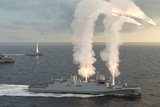
More suppliers join Type 26 programme


BAE Systems has awarded manufacturing equipment contracts to six more companies for Type 26 Global Combat Ship programme, bringing the total investment to date in the Type 26 supply chain to over £380 million, the company announced on 7 December.
The new contracts include equipment for the first three ships.
The contracts have been awarded to Rolls-Royce for steering gears and stabilisers; Johnsons Controls for chilled water plants; Marine Systems Technology for gastight, weathertight and watertight doors, hatches and scuttles and Hangar XY crane; and Salt Separation Services for reverse osmosis desalination plants. Detegasa has been contracted for membrane sewage treatment plants and oily water separators; and MEP–Pellegrini Marine Equipments for anchor handling and mooring equipment, boat davit, and radar cross section screen closures.
The combat systems team of BAE Systems is also now under contract to deliver the ships’ shared infrastructure and the electro-optical sensors control system, which detects and identifies potential threats in all weather conditions.
A total of 33 companies across the maritime supply chain are now working with BAE Systems to deliver the Type 26 ships.



More from Naval Warfare
-
![How France’s SNLE 3G programme is reshaping the naval nuclear industrial base]()
How France’s SNLE 3G programme is reshaping the naval nuclear industrial base
Extending far beyond a four-submarine replacement programme, France’s ballistic missile submarine effort is a decades-long industrial effort designed to preserve the country’s ability to build and sustain nuclear-powered strategic platforms.
-
![Quantum Systems enters maritime domain with Baltic-focused USV and UUV]()
Quantum Systems enters maritime domain with Baltic-focused USV and UUV
Quantum Systems has launched into the maritime domain with Seavex and Subvex, aiming to close a Baltic Sea ISR gap opened by infrastructure sabotage.
-
![Suppliers await next step in Australia’s mine warfare transition]()
Suppliers await next step in Australia’s mine warfare transition
Australia’s mine countermeasure capability remains in flux as the Huon-class nears retirement, but accelerated investment in autonomous systems is opening a path for industry.
-
![Can the US Navy ask Indo-Pacific allies to do more while training with them less?]()
Can the US Navy ask Indo-Pacific allies to do more while training with them less?
As the Iran War draws US ships and marine corps units away from the Indo-Pacific, curtailed exercises and a temporary carrier gap are exposing tensions between Washington’s demand for more self-reliant allies and the joint training needed to realise that ambition.
-
![How could Rheinmetall’s GMF 140 fit with ongoing programmes in North America?]()
How could Rheinmetall’s GMF 140 fit with ongoing programmes in North America?
With Canada committed to its River-class replacement and the USN pursuing a lower-cost frigate, Rheinmetall will need to demonstrate where the GMF 140 can fill a capability gap in the North American fleet.