Metal Shark delivers patrol boats to DCCG


Metal Shark has delivered four new high speed patrol boats to the Dutch Caribbean Coast Guard (DCCG) in Curacao, the company announced on 10 May.
The vessels are the first of 12 boats ordered in 2017. They will be used for patrolling the territorial waters of Aruba, Bonaire, Curacao, St Eustatius, St Maarten and Saba.
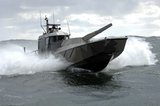
The welded aluminium, enclosed-pilothouse, 38 Defiant monohull patrol boats will replace the DCCG’s fleet of open-cockpit RIBs.
The vessels are powered by twin Cummins Marine QSB6.7 diesel engines and Konrad 680B counter-rotating dual-propulsion stern drives. The vessel has a top speed of more than 45kts. A fully-enclosed pilothouse protects the crew from the elements, while a ‘pillarless glass’ pilothouse arrangement provides unhampered day or night visibility. Composite armour panels provide ballistic crew protection.
A shock-mitigating seating arrangement has been provided for a crew of six, and anti-fatigue flooring has been placed in the pilothouse and the belowdecks crew spaces. For extended patrols at sea, the crew accommodations include an enclosed head compartment, galley and v-berth.
Additional vessels for the islands of Aruba and St Maarten are currently in production, with deliveries scheduled for later in 2018


More from Naval Warfare
-
![Canada assesses security equipment changes for Polar Icebreaker Imnaryuaq]()
Canada assesses security equipment changes for Polar Icebreaker Imnaryuaq
The Canadian Department of National Defence is evaluating communications and reconnaissance changes for CCGS Imnaryuaq’s expanded maritime security role, while retaining its 2032 acceptance target.
-
![US Navy’s MQ-25 Stingray approaches carrier-integration tests]()
US Navy’s MQ-25 Stingray approaches carrier-integration tests
Boeing has outlined its upcoming precision-landing and carrier-airspace trials as MQ-25 manufacturing shifts towards Illinois, with initial Lot 1 deliveries expected in 2029.
-
![From Poland to the Pacific: can Miecznik become a blueprint for other navies?]()
From Poland to the Pacific: can Miecznik become a blueprint for other navies?
Babcock is taking its Polish industrial partnership approach to Denmark and New Zealand as navies seek sovereign shipbuilding skills alongside ships.
-
![Unsettled waters in the North: can navies still trust their Arctic acoustic maps?]()
Unsettled waters in the North: can navies still trust their Arctic acoustic maps?
The changing Arctic environment is creating new challenges for submarine detection, driving demand for distributed sensors, uncrewed underwater vehicles and real-time acoustic modelling.