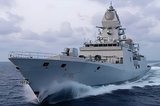
Madfox takes to the water
Madfox USV demonstrator. (Credit: LPhot Bradley/Crown Copyright)
A year of tests awaits for the latest UK Royal Navy uncrewed vessel.


The UK Royal Navy (RN) is continuing its efforts to explore the use of unmanned craft after welcoming into service the new Maritime Demonstrator For Operational Experimentation (Madfox) vessel.
Developed by L3Harris for NavyX ( the specialist wing of the RN that explores ways of boosting innovation in autonomous technologies), Madfox is derived from the Mast-13 vessel that underwent a series of trials beginning in late 2019.
‘Since being delivered, NavyX has been working hard to get Madfox to sea and ready to begin a demanding year of testing,’ the RN announced in a 26 March statement.
NavyX will carry out tests to see how USV technology can assist in surveillance and force protection operations.
‘With Madfox now directly in the hands of NavyX, the team will be able to explore a multitude of issues such as safety, regulatory compliance, new missions, new payloads and the role that a USV can play in complex operations and within the future fleet,’ said Cdr Antony Crabb, NavyX team leader.
As part of our promise to deliver comprehensive coverage to our Defence Insight and Premium News subscribers, our curated defence news content provides the latest industry updates, contract awards and programme milestones.
Related Equipment in Defence Insight

More from Naval Warfare
-
![Israeli Navy looks to expand as war reshapes future force requirements]()
Israeli Navy looks to expand as war reshapes future force requirements
Israel’s navy is preparing for a larger and more technically diverse role, but its ambitions could be impacted by supply chain restrictions, accelerating demand for domestic naval production as well as autonomous maritime capabilities.
-
![Competitive P17B tender marks a shift in Indian Navy frigate procurement]()
Competitive P17B tender marks a shift in Indian Navy frigate procurement
The Indian Navy's P17B programme is expected to combine greater weapons capacity with a competitive domestic construction model, although key systems could remain dependent on international supply chains.
-
![How France’s SNLE 3G programme is reshaping the naval nuclear industrial base]()
How France’s SNLE 3G programme is reshaping the naval nuclear industrial base
Extending far beyond a four-submarine replacement programme, France’s ballistic missile submarine effort is a decades-long industrial initiative designed to preserve the country’s ability to build and sustain nuclear-powered strategic platforms.
-
![China’s mineral processing dominance exposes naval supply chain vulnerabilities]()
China’s mineral processing dominance exposes naval supply chain vulnerabilities
Competition for critical minerals, and China’s dominance of their processing, is emerging as a decisive factor in future naval procurement programmes.