Leonardo’s LIONFISH® family targets the future (Sponsored)
Modular, common architecture, compactness, and lightweight: these are the key features of LIONFISH®, the new family of small-calibre remotely controlled naval turrets developed and produced by Leonardo.


This article is brought to you by Leonardo.
Drawing on the experience gained in the small- and medium-calibre sector and with an eye on technological evolution, Leonardo has developed the LIONFISH® family, leveraging the challenges imposed by modern operating scenarios.
The four models included in the family, Ultralight, Inner Reloading, Top (12.7 mm calibre) and 20 (20 mm calibre), have been designed for border control, maritime traffic interdiction, law enforcement, to counteract asymmetric aerial and surface threats and sudden attacks. The modularity of easy installation and deinstallation enable primary and secondary armament and a quick reconfiguration of the platforms on which the turrets are integrated.
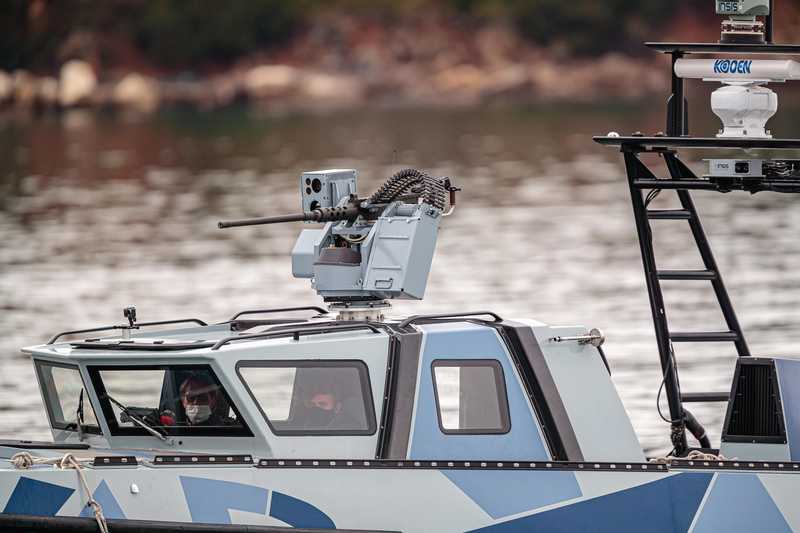
The LIONFISH® Ultralight variant of 12.7mm weighs less than 180 kg and is the lightest model in the whole family. The system is easily installed and is particularly effective against surface and airborne threats, such as drones and helicopters. With an effective range of 1,500 metres, its effectiveness has been successfully tested aboard the SWAD (Sea Watch Dog) Unmanned Surface Vehicle. Recently, the Ultralight turret, on board of a UTEK’s Unmanned Surface Vehicles KALUGA, participated in the REP MUS 21, the OTAN exercise dedicated to the exploration and testing of unmanned maritime systems, demonstrating its installation flexibility.
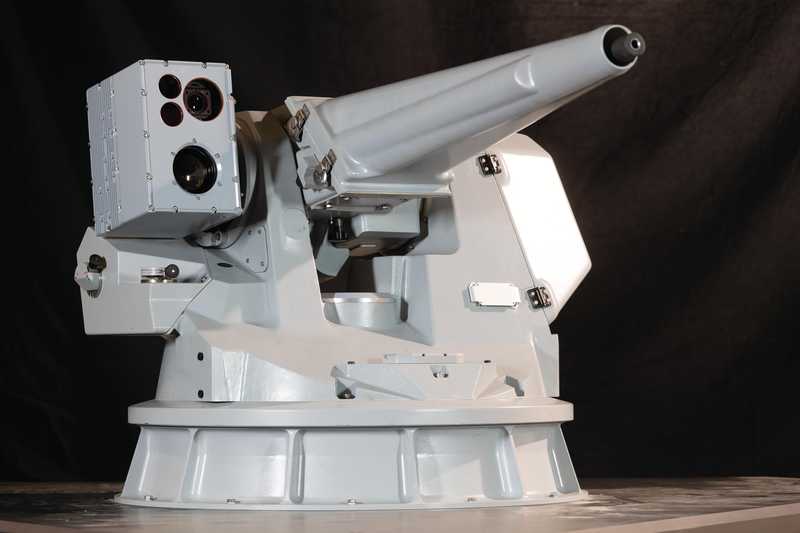
The Inner Reloading variant provides the operator with the ability to reload ammunition from below deck, improving safety during operations. It comes with stealth coverage, which makes it difficult to track by hostile radars. This model both with the Ultralight model can be used for land applications. With a weight of about 300 kg, the LIONFISH® Top is a particularly effective model for the most demanding Asymmetric Warfare (ASyW) requirements, due to its large magazine and for its high arc of elevation and depression range.
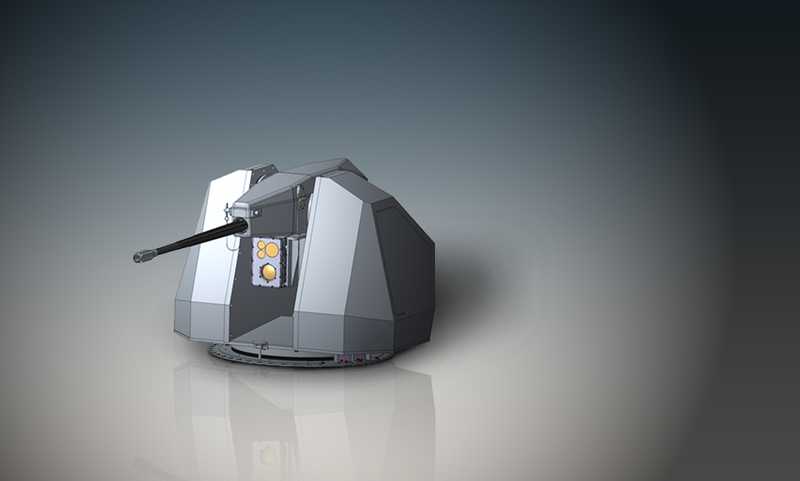
The LIONFISH® 20 model stands out for having the longest operational range and the highest rate of fire in the family.
In addition to the key features that stand out with the new turret family, there is a state-of-the-art optronic suite entirely produced by Leonardo, which enables sight and identification of a threat at a greater distance. It is the Mini-Colibrì system which can be fitted with an uncooled infrared sensor or a cooled infrared sensor. The LIONFISH® family’s highly accurate coaxial Electro-Optical sensor suite includes a daylight and infrared camera and a laser rangefinder that ensures effectiveness during complex scenarios and overnight operations.
The new turret family is designed to interface an external Firing Control System either limited to receive data for target designation or to be fully remotely controlled. Greater accuracy and optimized performance are also ensured by improved tracking algorithms.
The advanced auto-tracking device allows high manoeuvring and fast targeting ensuring maximum performance in targets engagement even when installed on high-speed vessels. High accuracy is guaranteed by independently performing ballistic and target trajectory calculations through an ammunition range table and own ship data to generate stabilised firing co-ordinates.
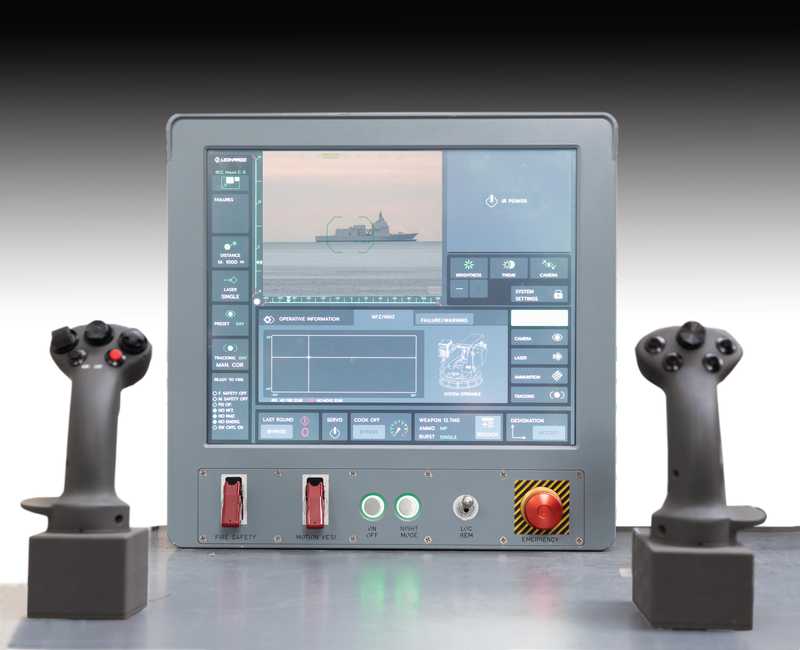
The common architecture is also reflected in the user-friendly IP65-certified Local Control Console shared by the whole family of turrets. It includes a widescreen, high-resolution monitor equipped with a touch screen presenting the turret’s command and control in a graphical user interface. The images from the turret’s electro-optical sensors can be displayed on the touch screen, allowing the crew to operate effectively even in risky scenarios.
The architectural solutions adopted guarantee excellent reliability and minimum maintenance times. The easy-to-use interface also minimises the time required for crew training. Greater safety for the crew is guaranteed by a pair of multifunctional, ergonomic joysticks, which can control the touch screen commands and allow for full control of the turret.

You may also like
More from Industry Spotlights
-
![How joint ventures are expanding Rheinmetall's munitions portfolio (video)]()
How joint ventures are expanding Rheinmetall's munitions portfolio (video)
Roman Köhne, CEO of Rheinmetall's Weapon and Ammunition Division, discusses the company's announcements at Eurosatory 2026, including developments in defence technology, precision systems, industrial partnerships and future capability programmes.
-
![From systems integrator to multi-domain solutions provider (video)]()
From systems integrator to multi-domain solutions provider (video)
Philipp von Brandenstein, Head of Corporate Communications at Rheinmetall, explains how Eurosatory 2026 marked a new stage in the company's evolution.
-
![Maximise survivability with advanced electronic warfare (video)]()
Maximise survivability with advanced electronic warfare (video)
BAE Systems’ all-digital EW delivers 360-degree threat awareness in contested environments, boosts survivability, and cuts lifecycle costs.
-
![“Timelines are measured in seconds”: tackling the UAS threat with dispersed defences]()
“Timelines are measured in seconds”: tackling the UAS threat with dispersed defences
Small uncrewed aerial systems (UAS) have transformed the battlespace, posing a complex threat across all domains. Militaries now need counter-UAS (CUAS) capabilities that defeat the danger while meeting demands around readiness, manoeuvrability and adaptability, according to Mike Spina, Director, Global Sales and Business Development for Targeting and Sensor Systems (TSS) at L3Harris Technologies.
-
![“No single technology is enough”: why an integrated approach to uncrewed warfare is essential]()
“No single technology is enough”: why an integrated approach to uncrewed warfare is essential
In Conversation… Ahmet Akyol, CEO of ASELSAN, talks to Shephard’s Gerrard Cowan about how the rapid evolution of uncrewed aerial systems (UAS) is transforming the battlespace, with militaries focused on both deploying these platforms to maximum effect and developing the defensive systems needed to counter them.
-
![Proteus: Forging the future of autonomous rotorcraft]()
Proteus: Forging the future of autonomous rotorcraft
As the home of British helicopters, Leonardo has worked with the UK Ministry of Defence for over a decade to advance technologies underpinning uncrewed rotorcraft. Today, in partnership with UK Defence Innovation and the Royal Navy, Leonardo is spearheading the next step in that journey: from remotely piloted technologies to fully autonomous systems.