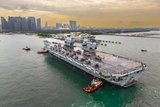
JFD completes subsea mating trials on Indian DSRV


JFD has successfully completed subsea mating exercises for the second of two submarine rescue flyaway systems delivered to the Indian Navy, the company announced on 8 May.
Through the course of the trials, JFD carried out multiple dives including underwater mating operations with a bottomed submarine and conducted a safe transfer of personnel from the submarine to the Deep Search and Rescue Vehicle (DSRV).
Throughout the sea trials and acceptance programme, JFD and the Indian Navy have conducted multiple dives of both the DSRV and the Remotely Operated Vehicle (ROV), in addition to side scan sonar operations, and pressurisation exercises of the deck decompression chambers.
Deep dives were conducted to a depth of 805m for the ROV and 650m for the DSRV, as well as an angled targeted mating exercise carried out at 45 degrees.
Following the completion of the sea acceptance trials, JFD will work with the Indian Navy to train the crew on the safe operation and maintenance of the system.
Giovanni Corbetta, managing director, JFD, said: ‘The sea acceptance trials for the second system have been conducted seamlessly between teams operating in both the UK and in-country, and we are pleased to have delivered all elements despite the geographical challenges faced by the teams.’
The system will be operated by the Indian Navy’s east coast-based rescue team.

You may also like
More from Naval Warfare
-
![US Navy begins SPY-6(V)4 radar testing ahead of first Arleigh Burke destroyer backfit]()
US Navy begins SPY-6(V)4 radar testing ahead of first Arleigh Burke destroyer backfit
Wallops Island trials will validate the next-generation radar's combat system integration before its installation aboard USS Pinckney, the first Flight IIA destroyer to receive the SPY-6(V)4 upgrade.
-
![Hanwha Ocean deepens US ties and eyes Saudi submarine prospect after Canada setback]()
Hanwha Ocean deepens US ties and eyes Saudi submarine prospect after Canada setback
Hanwha Ocean is deepening ties with the US and eyeing a submarine opportunity in Saudi Arabia, as South Korea looks to convert its Canadian defeat into export momentum.
-
![A400M trial demonstrates airborne deployment of uncrewed surface vessel]()
A400M trial demonstrates airborne deployment of uncrewed surface vessel
Kraken Technology Group’s A400M airdrop of a K3 Scout uncrewed surface vessel points to a new way for navies to insert USVs into contested waters, bypassing ports and motherships.
-
![Babcock onshores 85% of Canada’s submarine supply chain as it eyes future CPSP programme]()
Babcock onshores 85% of Canada’s submarine supply chain as it eyes future CPSP programme
By moving most of the Royal Canadian Navy’s submarine supply chain into Canada, Babcock Canada is driving to strengthen sovereign sustainment capabilities while preparing to compete to maintain the future Canadian Patrol Submarine Project.
-
![From the seas to the web: the changing shape of UK defence in Southeast Asia]()
From the seas to the web: the changing shape of UK defence in Southeast Asia
As his final engagement before leaving his post as the head of the British defence staff for Southeast Asia and defence adviser to Singapore, Brigadier Eddie Maskell-Pedersen spoke with Shephard about maritime security, cyber cooperation and long-term partnerships.