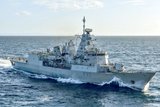
Japanese navy appoints first female chief of warship unit


The Japanese navy said on 6 March it had for the first time appointed a woman as commander of a unit that includes the country’s biggest warship.
Ryoko Azuma, 44, will command four warships making up a division with a total of 1,000 crew members.
A spokesman for the Japan Maritime Self-Defense Force told AFP: ‘This is the first time a woman was appointed for the job. But she wasn’t chosen because she was a woman.’
The ships include the helicopter carrier Izumo, the navy’s biggest ship.
Azuma, after a ceremony at Yokohama near Tokyo to mark her arrival in the post, said: ‘I want to do my best to carry out the heavy duty I have been given.’
About 400 crew members attended the ceremony.
Azuma said: ‘I don’t think about being a woman but I want to try to become a role model for younger female officers.’
About 14,000 women are currently serving in the Self-Defense Forces as the military is known, accounting for only 6% of the entire personnel.
On most levels, Japan lags behind other developed countries in terms of sexual equality.
In politics women are still under-represented with only 47 of the 465 members of the lower house.
According to statistics compiled by the Swiss-based Inter-Parliamentary Union, this ratio of 10.1% places Japan below Myanmar and Gambia.

You may also like

More from Naval Warfare
-
![Russia’s uncrewed boat portfolio hints at future naval demand]()
Russia’s uncrewed boat portfolio hints at future naval demand
Ukrainian intelligence has catalogued more than 20 Russian uncrewed surface vessels, revealing a portfolio weighted towards mine warfare and logistics, with implications for Western naval investment.
-
![Ukraine’s new long-range 12m autonomous vessel can deploy other drones]()
Ukraine’s new long-range 12m autonomous vessel can deploy other drones
Ukraine’s UForce unveiled the MV11 uncrewed surface vessel, designed to launch and support other naval drones at sea, fuelling debate over the future of autonomous maritime task groups.
-
![German Navy’s Israeli missile test points to deepening defence-industrial ties]()
German Navy’s Israeli missile test points to deepening defence-industrial ties
The test-firing of an Israel Aerospace Industries LORA ballistic missile from a German vessel highlights the Bundeswehr’s focus on speed to capability as it trials Israel’s operationally proven technology.
-
![Global submarine suppliers compete for a rapidly shrinking market]()
Global submarine suppliers compete for a rapidly shrinking market
Diminishing submarine competitions worldwide are leaving fewer acquisition opportunities, pushing contractors toward alternatives.
-
![Future frigate programme highlights broader RNZN replacement challenge]()
Future frigate programme highlights broader RNZN replacement challenge
New Zealand’s evaluation of the Mogami and Arrowhead 140 frigate designs reflects a wider push for alliance interoperability, and points to a larger recapitalisation of the Royal New Zealand Navy fleet beyond the current programme.