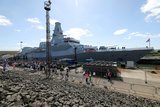
Japan reportedly conducts submarine drill in South China Sea


Japan has carried out its first submarine drill in the South China Sea, a newspaper said on 17 September, a move that could provoke Beijing which claims most of the disputed waters.
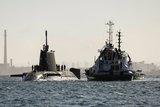
Submarine Kuroshio on 13 September joined three Japanese warships in waters just southwest of the China-controlled Scarborough Shoal, the Asahi Shimbun said.
China claims most of the resource-rich South China Sea, through which $5 trillion in shipping trade passes annually, despite competing claims from Brunei, Malaysia, the Philippines, Taiwan and Vietnam.
Tensions have been high over the Scarborough Shoal since it was seized from Manila by Beijing in 2012.
The newspaper said the submarine exercises were Tokyo's first in the South China Sea.
Japan's Maritime Self-Defence Force carried out a ‘practical’ anti-submarine drill, including an exercise to spot enemy submarines with sonar devices, Asahi said, quoting unnamed Japanese government sources.
The sources said it was a legitimate naval exercise in neutral waters, with rights of access secured under international law.
Following the drill, the Japanese submarine plans to make a port call on 17 September at Cam Ranh, central Vietnam, in a bid to display Tokyo's defence cooperation with Hanoi, Asahi said.
It will be the first call by a submarine at the strategically important port since the Second World War, it added.
The disputed South China Sea contains vital global shipping routes and what are believed to be significant oil and natural gas deposits.
China has engaged in years of land-reclamation efforts on reefs it controls in the region, and built both civilian and military facilities in the contested area.
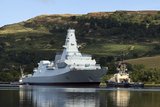
Earlier in September 2018, Beijing lashed out at Britain for sending a warship close to the disputed islands – one of a series of ‘freedom of navigation’ operations carried out in recent times by the US and its allies as a signal to Beijing of their right to access the disputed waters.
Immediate confirmation of the Asahi Shimbun report was not available.

You may also like
More from Naval Warfare
-
![What the rise of interoperability between Western allies means for defence procurement]()
What the rise of interoperability between Western allies means for defence procurement
Major naval initiatives including the European Patrol Corvette programmes and Norway’s UK partnership-focused purchase of Type 26 frigates point to the growing interest in the advantages of commonality across allied navies.
-
![Kraken’s Royal Navy USV contract signals next step in crewed-uncrewed integration]()
Kraken’s Royal Navy USV contract signals next step in crewed-uncrewed integration
The UK Royal Navy’s rapid procurement of uncrewed platforms aligns with the force’s strategic shift towards a fleet better equipped to handle modern threats.
-
![HMS Anson’s milestone stay in Australia cut short during AUKUS deployment]()
HMS Anson’s milestone stay in Australia cut short during AUKUS deployment
The Astute-class submarine’s visit to Australia was the first time maintenance activity on a UK Royal Navy nuclear submarine had been carried out in the country.
-
![How Operation Epic Fury could reduce US readiness to face China]()
How Operation Epic Fury could reduce US readiness to face China
The offensive against Iran could impact training and maintenance cycles and accelerate the degradation of the US arsenal on top of depleting Washington’s stockpiles.
-
![UK Royal Navy explores modular counter-drone capabilities for future hybrid fleet]()
UK Royal Navy explores modular counter-drone capabilities for future hybrid fleet
The UK MoD is scoping out systems to counter the growing threat of uncrewed aerial systems, with a focus on low-cost modularity and speed to field.