Italy eyes naval drone carrier opportunities under Project Sciamano
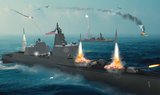
An artist’s impression of Portugal's Plataforma Naval Multifuncional ship. The Italian Sciamano project looks to be taking a similar approach. (Image: Portuguese MoD)
Italy has revealed details of a new programme to develop a naval vessel designed to act as a mothership for uncrewed systems.


The programme, dubbed Sciamano, aims to deliver a concept design for the Sciamano Drone Carrier (SDC). The SDC will feature a control, command and communication (C3) network intended to operate drone swarms along with dedicated launch and recovery systems (LARS).
According to a document published by the Italian MoD in October, work on Sciamano will start with a study phase, focused on setting out requirements and identifying appropriate technologies.
The effort will then move on to conceptual design of subsystems, a critical stage that will help steer technical and operational requirements for the SDC.
Phase 2 will involve creation of a virtual model of
Our news & analysis is now part of Defence Insight®
A Basic-level or higher Defence Insight subscription is now required to view this content.


More from Naval Warfare
-
![US turns to allies to tackle navy shipbuilding backlog]()
US turns to allies to tackle navy shipbuilding backlog
A White House memorandum acknowledges US Navy shipbuilding backlogs and a weakened industrial base, opening a formal path for South Korean and Japanese yards to help rebuild capacity.
-
![US Navy’s $275 billion BBGN plan hinges on shipyard transformation]()
US Navy’s $275 billion BBGN plan hinges on shipyard transformation
The US Navy’s planned nuclear-powered warship carries a US$275 billion price tag, but the greater story lies in the industrial overhaul needed to build it, from AI-enabled design to digital twins and modular construction.
-
![Industry sees opportunity in Australia’s shift to networked undersea warfare]()
Industry sees opportunity in Australia’s shift to networked undersea warfare
Australia’s new defence innovation strategy indicates a shift from platform-centric to network-centric undersea warfare, with Ocius and Anduril Industries pointing to fast-growing opportunities for local industry.
-
![Asia-Pacific emerges as the largest export market for US-made USVs]()
Asia-Pacific emerges as the largest export market for US-made USVs
Asian customers have placed one of the largest known international purchases of US-built uncrewed surface vessels, highlighting accelerating regional demand for autonomous maritime capabilities and distributed naval operations.