


Australian industry programme builds pipeline for Virginia-class sustainment
Australian businesses can now bid to support Virginia-class submarine sustainment in Western Australia, as momentum around the Henderson Defence Precinct also builds.


Northrop Grumman completed a critical test in the development of the Integrated Topside (InTop) Low-Level Resource Allocation Manager (LLRAM) programme in partnership with the US Naval Research Laboratory (NRL).
The LLRAM was demonstrated in conjunction with the the InTop Electronic Warfare/Information Operations/Communications (EW/IO/COMMS) system at the NRL’s test facility in Chesapeake Beach, Maryland.
The system demonstrated the simultaneous sharing of a single antenna, while flexing its adaptable size and antenna pattern capabilities, and performing a mission that would have previously required multiple dedicated antennas. The test was carried out as part of work to enable future antenna reductions on ships that are already capacity-constrained, allowing for more advanced capabilities in an ever-increasingly complex battlespace environment.
The demonstration showed that the EW/IO/COMMS Advanced Development Model for SEWIP Block 3 can serve as a platform for proving out advanced multi-function concepts using existing NRL test assets.
Mike Meaney, vice president, maritime electronic and information warfare, Northrop Grumman, said: ‘The Northrop Grumman/NRL demonstration of LLRAM concepts was conducted in the same environment that proved crucial to the development of the SEWIP Block 3 EDM.
‘The efficiency of signal sharing capabilities, scalability and advanced resource management capabilities developed on the LLRAM programme will allow for a significantly reduced footprint topside.’
The system leverages four AESA arrays (low band transmit/receive and high band transmit/receive) and intended platforms include cruisers, destroyers and aircraft carriers.


Australian businesses can now bid to support Virginia-class submarine sustainment in Western Australia, as momentum around the Henderson Defence Precinct also builds.
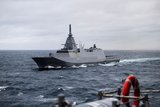
Washington’s search for a foreign-built frigate could hand South Korea, Japan and Turkey a larger prize than a double-hull order: a foothold inside the US shipbuilding industrial base.
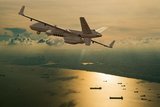
Japan’s FY2027 defence budget backs stand-off strike, a 17-aircraft MQ-9B buy and a declared bid to lead the world in uncrewed maritime assets, alongside new frigates, submarines and support ships.
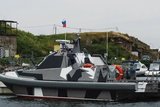
Ukrainian intelligence has catalogued more than 20 Russian uncrewed surface vessels, revealing a portfolio weighted towards mine warfare and logistics, with implications for Western naval investment.
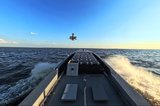
Ukraine’s UForce unveiled the MV11 uncrewed surface vessel, designed to launch and support other naval drones at sea, fuelling debate over the future of autonomous maritime task groups.
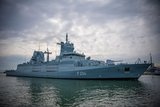
The test-firing of an Israel Aerospace Industries LORA ballistic missile from a German vessel highlights the Bundeswehr’s focus on speed to capability as it trials Israel’s operationally proven technology.

Connect with us on socials


