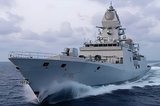
Industry sees opportunity in Australia’s shift to networked undersea warfare
Australia’s Ghost Shark extra-large autonomous underwater vehicle. (Photo: Rodney Braithwaite/Australian Government Defence)
Australia’s new defence innovation strategy indicates a shift from platform-centric to network-centric undersea warfare, with Ocius and Anduril Industries pointing to fast-growing opportunities for local industry.


Australia’s Department of Defence (DoD) has signalled a shift away from platform-centric undersea procurement, with its 2026 Defence Innovation, Science and Technology Strategy (DISTS) describing a future built around autonomous sensor networks, artificial intelligence-enabled acoustic processing and distributed surveillance.
The Ghost Shark extra-large autonomous undersea vehicle (XL-AUV) and the SSN-AUKUS submarine programme have grabbed Australian industry attention. However, the DISTS – published by the DoD in July 2026 – reads like a blueprint for an “integrated Defence Innovation, Science and Technology Ecosystem” intended to move technology from research to the warfighter “at the speed of relevance”.
Defence Minister Richard Marles
Our news & analysis is now part of Defence Insight®
A Basic-level or higher Defence Insight subscription is now required to view this content.

More from Naval Warfare
-
![Competitive P17B tender marks a shift in Indian Navy frigate procurement]()
Competitive P17B tender marks a shift in Indian Navy frigate procurement
The Indian Navy's P17B programme is expected to combine greater weapons capacity with a competitive domestic construction model, although key systems could remain dependent on international supply chains.
-
![China’s mineral processing dominance exposes naval supply chain vulnerabilities]()
China’s mineral processing dominance exposes naval supply chain vulnerabilities
Competition for critical minerals, and China’s dominance of their processing, is emerging as a decisive factor in future naval procurement programmes.
-
![Suppliers await next step in Australia’s mine warfare transition]()
Suppliers await next step in Australia’s mine warfare transition
Australia’s mine countermeasure capability remains in flux as the Huon-class nears retirement, but accelerated investment in autonomous systems is opening a path for industry.
-
![Can the US Navy ask Indo-Pacific allies to do more while training with them less?]()
Can the US Navy ask Indo-Pacific allies to do more while training with them less?
As the Iran War draws US ships and marine corps units away from the Indo-Pacific, curtailed exercises and a temporary carrier gap are exposing tensions between Washington’s demand for more self-reliant allies and the joint training needed to realise that ambition.