Indonesia receives two minehunters and makes progresses on two Arrowhead 140 frigates
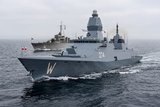
The Indonesian Navy has received its two German-built mine countermeasures vessels. (Photo: TNI-AL)
Two German-built minehunters have been accepted into the Indonesian navy, while PT PAL is busy building two new frigates for the Indonesian Navy.


The Indonesian Navy (TNI-AL) commissioned two 62m-long mine countermeasures vessels (MCMV) – KRI Pulau Fani (731) and KRI Pulau Fanildo (732) – in Surabaya on 14 August.
At their induction ceremony, the MCMVs participated in a sail-past alongside five KCR-60M fast attack craft and the trimaran KRI Golok. They had been transported by sea from Bremerhaven, Germany, to Indonesia via the heavy load carrier Combi Dock I.
The new vessels have been allocated to the minesweeper unit of the 2nd Fleet Command, headquartered in Surabaya, East Java.
The boats had been ordered from Abeking & Rasmussen under a
Our news & analysis is now part of Defence Insight®
A Basic-level or higher Defence Insight subscription is now required to view this content.



More from Naval Warfare
-
![All eyes on Royal Navy’s Type 93 market engagement as industry prepares bids]()
All eyes on Royal Navy’s Type 93 market engagement as industry prepares bids
Responses are due by 29 October as the Royal Navy tests the market, with BAE Systems’ Herne and MSubs’ Excalibur setting up a contest where payloads may decide the winner.
-
![From Poland to the Pacific: can Miecznik become a blueprint for other navies?]()
From Poland to the Pacific: can Miecznik become a blueprint for other navies?
Babcock is taking its Polish industrial partnership approach to Denmark and New Zealand as navies seek sovereign shipbuilding skills alongside ships.
-
![Unsettled waters in the North: can navies still trust their Arctic acoustic maps?]()
Unsettled waters in the North: can navies still trust their Arctic acoustic maps?
The changing Arctic environment is creating new challenges for submarine detection, driving demand for distributed sensors, uncrewed underwater vehicles and real-time acoustic modelling.