Huntington Ingalls Industries showcase new Proteus vessel
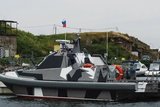
Huntington Ingalls Industries, Technical Solutions has debuted their Proteus USV. (Photo: Huntington Ingalls Industries)
Huntington Ingalls’ Proteus vessel successfully executed its autonomy capabilities demonstration.


Huntington Ingalls Industries has announced the debut of the Proteus unmanned surface vessel (USV) for testing and development of autonomous capabilities.
The 27ft Proteus USV was outfitted with Sea Machines Robotics’ SM300 autonomy system and completed a successful demonstration on 14 May.
For the demonstration, the Proteus was equipped with commercial perception sensors, including GPS; automatic identification system; depth transducer; radar and a camera enabling 360˚ field of view.
Huntington Ingalls deployed a separate 51ft dive boat during the demonstration to illustrate SM300 system’s off-the-shelf solution, including its obstacle avoidance capability and adherence to the International Regulations for Preventing Collisions at Sea.
The Proteus USV will enable Huntington Ingalls’ continued development of autonomous capabilities and sensor fusion to support the evolving needs of both government and commercial customers.
Huntington Ingalls announced its minority share investment in Sea Machines in July 2020.
Sea Machines’ SM300 system can be outfitted to ocean capable vessels to enable scalable autonomy, from remotely controlled to fully autonomous vessel operations.
According to Shephard Defence Insight, the vessel comprises a multi-mission vessel capable of being re-roled as a swimmer delivery vehicle to support the full spectrum of special operations.
Related Equipment in Defence Insight



More from Naval Warfare
-
![Ukraine’s new long-range 12m autonomous vessel can deploy other drones]()
Ukraine’s new long-range 12m autonomous vessel can deploy other drones
Ukraine’s UForce unveiled the MV11 uncrewed surface vessel, designed to launch and support other naval drones at sea, fuelling debate over the future of autonomous maritime task groups.
-
![German Navy’s Israeli missile test points to deepening defence-industrial ties]()
German Navy’s Israeli missile test points to deepening defence-industrial ties
The test-firing of an Israel Aerospace Industries LORA ballistic missile from a German vessel highlights the Bundeswehr’s focus on speed to capability as it trials Israel’s operationally proven technology.
-
![Global submarine suppliers compete for a rapidly shrinking market]()
Global submarine suppliers compete for a rapidly shrinking market
Diminishing submarine competitions worldwide are leaving fewer acquisition opportunities, pushing contractors toward alternatives.
-
![Melting ice is rewriting Arctic naval requirements]()
Melting ice is rewriting Arctic naval requirements
As the High North opens to shipping, navies face rising demand for icebreakers, ASW vessels, uncrewed systems and surveillance assets far beyond the submarine fleet.