German-Filippino defence collaboration agreement edges closer in South China Sea
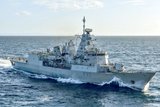
Warships on exercises in the South China Sea. (Photo: US Navy)
The countries have agreed to have a collaboration plan in place by the end of 2024.


Germany and the Philippines have agreed to speed up plans to set up a defence collaboration agreement before the end of 2024.
The two nations were already keen to set up such an agreement, but while Russia’s war in Ukraine continues, and Gaza dominates headlines worldwide, Germany and the Philippines are concerned with Chinese militarism in the South China Sea.
The South China Sea is a vital trade route for much of the world and includes areas claimed as exclusive economic zones by Vietnam, the Philippines, Malaysia, Brunei and Indonesia.
China believes almost the entire South China Sea is the sovereign possession of China.
In 2016, the Permanent Court of Arbitration in the Hague said China’s claims to exclusive possession of the South China Sea had no basis in international law, based on application of the United Nations Convention on the Law of the Sea (UNCLOS).
China, home to the second largest economy in the world and the largest army, disagrees. It also has a history of being unmoved by the opinions of the rest of the world over what it does and does not own.
The South China Sea is extremely important in the world marketplace: US$3.4 trillion of the world’s $16 trillion maritime shipping travels via the sea. It acts as a major trade conduit, carrying around 5% of the world’s GDP.
The Philippines has long had concerns about Chinese claims in the South China Sea. It began the 2016 arbitration which saw the sea declared as officially not a sovereign possession of China. In 2020, the Philippines also expressed its concern about 220 Chinese military vessels scattered around the South China Sea.
And while the world’s attention has been on larger conflicts in recent months, China and the Philippines have been trading accusations and insults about one another’s actions in the area. In particular, Manila has accused Chinese military forces of intentionally and illegally ramming Filipino naval vessels during a resupply mission to the Second Thomas Shoal. China does not dispute the fact of the ramming but insists its actions were lawful.
Such elevations of tension in the South China Sea have spurred Germany and the Philippines to accelerate the timeline of their defence agreement. While the precise details of the agreement have yet to be hammered out, both countries assert that the deal will facilitate joint military training and possible sale of German weapons to the Philippines to address counter-security challenges.
That language has been bolstered by a recent US commitment of $500 million to modernise the Filipino army. The US has previously run naval exercises in the South China Sea. The modernisation money, allied to the German-Filipino defence agreement, suggests a growing union of Western and Southeast Asian governments preparing their military readiness in the region.
Related Programmes in Defence Insight
Naval: Combat Management Systems | Multi-Role Response Vessels [Philippines]

You may also like

More from Naval Warfare
-
![Russia’s uncrewed boat portfolio hints at future naval demand]()
Russia’s uncrewed boat portfolio hints at future naval demand
Ukrainian intelligence has catalogued more than 20 Russian uncrewed surface vessels, revealing a portfolio weighted towards mine warfare and logistics, with implications for Western naval investment.
-
![Ukraine’s new long-range 12m autonomous vessel can deploy other drones]()
Ukraine’s new long-range 12m autonomous vessel can deploy other drones
Ukraine’s UForce unveiled the MV11 uncrewed surface vessel, designed to launch and support other naval drones at sea, fuelling debate over the future of autonomous maritime task groups.
-
![German Navy’s Israeli missile test points to deepening defence-industrial ties]()
German Navy’s Israeli missile test points to deepening defence-industrial ties
The test-firing of an Israel Aerospace Industries LORA ballistic missile from a German vessel highlights the Bundeswehr’s focus on speed to capability as it trials Israel’s operationally proven technology.
-
![Global submarine suppliers compete for a rapidly shrinking market]()
Global submarine suppliers compete for a rapidly shrinking market
Diminishing submarine competitions worldwide are leaving fewer acquisition opportunities, pushing contractors toward alternatives.
-
![Future frigate programme highlights broader RNZN replacement challenge]()
Future frigate programme highlights broader RNZN replacement challenge
New Zealand’s evaluation of the Mogami and Arrowhead 140 frigate designs reflects a wider push for alliance interoperability, and points to a larger recapitalisation of the Royal New Zealand Navy fleet beyond the current programme.