FMV signs contract for next phase of Torped 62 life extension
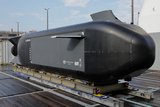
Torped 62 heavyweight torpedo. (Image: Saab)
Swedish heavyweight torpedo to benefit from more life extension work by Saab.


Swedish defence procurement agency FMV has placed an SEK145 million ($16.07 million) contract with Saab for the next phase of the Torped 62 life extension programme.
Production and development will take place in Linköping and Motala with deliveries scheduled ‘by the end of 2023’, Saab announced on 16 December. ‘The order includes pre-studies and engineering which incorporates subsystem prototypes for improvements of the current torpedo.’
The initial SEK485 million contract with Saab for the Torped 62 life extension was signed in 2020.
Described by Görgen Johansson, head of the Dynamics business unit in Saab, as ‘one of the Swedish Navy’s main weapon systems’, Torped 62 is a heavyweight torpedo system for surface and underwater targets. It is equipped with a high-capacity and long-endurance propulsion system, combined with an advanced target seeker.
Related Equipment in Defence Insight

More from Naval Warfare
-
![US turns to allies to tackle navy shipbuilding backlog]()
US turns to allies to tackle navy shipbuilding backlog
A White House memorandum acknowledges US Navy shipbuilding backlogs and a weakened industrial base, opening a formal path for South Korean and Japanese yards to help rebuild capacity.
-
![US Navy’s $275 billion BBGN plan hinges on shipyard transformation]()
US Navy’s $275 billion BBGN plan hinges on shipyard transformation
The US Navy’s planned nuclear-powered warship carries a US$275 billion price tag, but the greater story lies in the industrial overhaul needed to build it, from AI-enabled design to digital twins and modular construction.
-
![Industry sees opportunity in Australia’s shift to networked undersea warfare]()
Industry sees opportunity in Australia’s shift to networked undersea warfare
Australia’s new defence innovation strategy indicates a shift from platform-centric to network-centric undersea warfare, with Ocius and Anduril Industries pointing to fast-growing opportunities for local industry.
-
![Asia-Pacific emerges as the largest export market for US-made USVs]()
Asia-Pacific emerges as the largest export market for US-made USVs
Asian customers have placed one of the largest known international purchases of US-built uncrewed surface vessels, highlighting accelerating regional demand for autonomous maritime capabilities and distributed naval operations.