Fifth Astute-class submarine undergoes milestone test
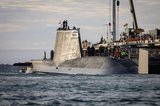
As well as the Astute Class, BAE Systems is delivering the Dreadnought submarines for the Royal Navy. (Photo: BAE Systems)
BAE Systems announces the Anson Astute-class submarine has successfully completed a trim dive.


BAE Systems has announced its fifth Barrow-built Astute-class submarine, named Anson, successfully submerged beneath the surface of the water while the crew tested onboard systems.
The exercise proved the safety and stability of the 7,400t, 97m-long attack submarine.
Commander David ‘Bing’ Crosby, Commanding Officer of Anson, said: ‘This [trim dive] will enable us to set the boat’s internal weight, prove her water-tight integrity, test sensors and put some of our systems through their tests’.
During a trim dive, the submarine is submerged 15m to complete a number of tests, the most essential of which is to help establish the vessel’s centre of gravity and precise weight.
More than 60 crew embers were on board as part of the exercise, which saw tonnes of ballast taken aboard to assist in testing the vessel’s stability.
HMS Astute, HMS Artful, HMS Ambush and HMS Audacious are already in service. The sixth and seventh submarines, Agamemnon and Agincourt, are at different stages of construction at the Barrow shipyard.
Related Equipment in Defence Insight




More from Naval Warfare
-
![Five years on: where could opportunities emerge next for AUKUS Pillar II?]()
Five years on: where could opportunities emerge next for AUKUS Pillar II?
Payload commonality, combat systems and electronic warfare are emerging as likely priorities as the trilateral partnership balances building submarines with sharing industrial ecosystems.
-
![Singapore expands maritime presence with future-ready Sentinel OPV]()
Singapore expands maritime presence with future-ready Sentinel OPV
Singapore is building space for uncrewed systems and future technologies into its new Sentinel-class OPVs, reflecting a wider move towards adaptable vessels capable of maintaining persistent maritime presence.
-
![From the Baltic to the Gulf: where USV procurement is heading next]()
From the Baltic to the Gulf: where USV procurement is heading next
Saildrone’s new Copenhagen base is one sign of a larger shift, as navies globally turn to uncrewed vessels for surveillance and mine clearance.
-
![Israeli Navy looks to expand as war reshapes future force requirements]()
Israeli Navy looks to expand as war reshapes future force requirements
Israel’s navy is preparing for a larger and more technically diverse role, but its ambitions could be impacted by supply chain restrictions, accelerating demand for domestic naval production as well as autonomous maritime capabilities.
-
![Quantum sensing gathers pace as navies eye undersea advantage]()
Quantum sensing gathers pace as navies eye undersea advantage
As AI dominates defence conversations, industry increasingly points to quantum sensing as the technology set to change submarine and uncrewed underwater vehicle operations.