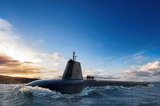
Euronaval 2022: Airbus and Rohde & Schwarz eye naval benefits of future 6G communications
Airbus Defence and Space and Rohde & Schwarz aim to bring 6G secure communications to the naval domain. (Photo: Rohde & Schwarz)
6G secure communications remain at a nascent stage but Airbus and Rohde & Schwarz aim to bring the benefits to navies.


Airbus Defence and Space and Rohde & Schwarz are cooperating ‘to bring integrated sixth-generation [6G] secure communications and electronic support solutions to navies’, the two companies announced on 19 October during Euronaval 2022 in Paris.
6G defence technologies ‘will revolutionise military secure communications and cooperative intelligence. This will enable the navy to better exploit the huge amount of information collected and distributed’, said Hansjörg Herrbold, VP of secure communications at Rohde & Schwarz.
With 6G, both companies expect that navies would benefit from extremely low latency communications of one microsecond, or 1,000 times faster than one millisecond. 6G-enabled networks would also be able to operate at higher frequencies than 5G.
Mobile edge computing with AI capabilities will be built into all 6G networks, whereas it must be added to existing 5G networks.
However, 6G is not yet ready for the field. Some commercial vendors are devoting R&D funds to the technology but industry and government specifications for 6G network-enabled solutions remain undefined.



More from Naval Warfare
-
![Europe’s naval contractors benefit from growing refit and upgrade demand]()
Europe’s naval contractors benefit from growing refit and upgrade demand
Rheinmetall’s order to modernise the German Navy frigate Bayern points to a wider European shift towards extending warship service life as new-build programmes face delay.
-
![The UK joins the movement towards joint procurement]()
The UK joins the movement towards joint procurement
The UK will spend an estimated US$3.89 billion over the next decade in joint naval programmes, a lot of which will be in cooperation with Norway.
-
![Rheinmetall’s GMF 140: Ambitious frigate or market misfit?]()
Rheinmetall’s GMF 140: Ambitious frigate or market misfit?
Rheinmetall has unveiled its first next-generation frigate design, showing ambitions to compete as a surface combatant prime contractor. While the company is targeting North America, analysts believe the concept may be better positioned for future European programmes.
-
![US Navy $76.6bn award provides stability for submarine production]()
US Navy $76.6bn award provides stability for submarine production
The US Department of War’s US$76.6 billion Columbia-and Virginia-class submarine contract gives industry demand certainty as Washington seeks to rebuild its shipbuilding base.
-
![Dreadnought Phase 4 opens £2.5 billion supply chain opportunity]()
Dreadnought Phase 4 opens £2.5 billion supply chain opportunity
The UK government’s £8.4 billion Dreadnought Phase 4 investment sets aside £2.5 billion for the wider submarine supply chain, opening new work beyond BAE Systems’ prime contract.