Ecuador turns to local shipyard and international suppliers for military platforms
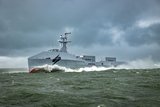
Shipbuilding has been slow in Ecuador despite the country’s objective to combat criminal activities along the coast. (Photo: Astinave)
As Ecuador attempts to combat so-called “terrorist networks”, the country has turned to the US and Turkey for equipment, while domestic construction and acquisition of new naval platforms has remained a slow process.


Ecuadorian state-run shipyard Astinave has declared a multipurpose vessel under construction for the Ecuadorian Navy to be 65% complete. A shipyard spokesperson explained to Shephard that the vessel, the future BAE Ruminahui, would be “ready by end of this year before undergoing sea trials”. The ship will be delivered to the Navy by the end of 2025.
The multipurpose vessel, the first of its class that the shipyard has built, has a length of 75m and capacity for a 12-ton helicopter. It will be equipped with Astinave’s Orion command and control system and will have a crew of 66.
Our news & analysis is now part of Defence Insight®
A Basic-level or higher Defence Insight subscription is now required to view this content.

More from Naval Warfare
-
![How France’s SNLE 3G programme is reshaping the naval nuclear industrial base]()
How France’s SNLE 3G programme is reshaping the naval nuclear industrial base
Extending far beyond a four-submarine replacement programme, France’s ballistic missile submarine effort is a decades-long industrial initiative designed to preserve the country’s ability to build and sustain nuclear-powered strategic platforms.
-
![Quantum Systems enters maritime domain with Baltic-focused USV and UUV]()
Quantum Systems enters maritime domain with Baltic-focused USV and UUV
Quantum Systems has launched into the maritime domain with Seavex and Subvex, aiming to close a Baltic Sea ISR gap opened by infrastructure sabotage.
-
![China’s mineral processing dominance exposes naval supply chain vulnerabilities]()
China’s mineral processing dominance exposes naval supply chain vulnerabilities
Competition for critical minerals, and China’s dominance of their processing, is emerging as a decisive factor in future naval procurement programmes.
-
![Suppliers await next step in Australia’s mine warfare transition]()
Suppliers await next step in Australia’s mine warfare transition
Australia’s mine countermeasure capability remains in flux as the Huon-class nears retirement, but accelerated investment in autonomous systems is opening a path for industry.
-
![Can the US Navy ask Indo-Pacific allies to do more while training with them less?]()
Can the US Navy ask Indo-Pacific allies to do more while training with them less?
As the Iran War draws US ships and marine corps units away from the Indo-Pacific, curtailed exercises and a temporary carrier gap are exposing tensions between Washington’s demand for more self-reliant allies and the joint training needed to realise that ambition.