China innovates with ‘drone’ mothership, USVs and semi-submersible transports
An artist’s rendering of the Zhu Hai Yun maritime research vessel, which has potential to steer naval utilisation or even to conduct military tasks itself. (Tsinghua University)
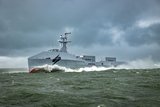
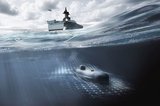
China continues to invest heavily in new capabilities, with a ‘drone mothership’, new stealth USVs, semi-submersible mobile platforms and landing craft all appearing in recent weeks.


China launched what is claimed to be the world’s first ‘drone’ mothership – one designed to carry multiple UAVs, UUVs and USVs – in Guangzhou on 18 May.
The futuristic-looking 88.5m-long ship is christened Zhu Hai Yun, and it is believed it can carry up to 50 autonomous vehicles. It has a vast stern deck that can accommodate all manner of UUVs, USVs and UAVs.
The 2,000t vessel was constructed by the Huangpu-Wenchong Shipyard, with work beginning in July 2021.
Huangpu is a subsidiary of the China State Shipbuilding Corporation (CSSC), and this novel mothership was built alongside naval
Our news & analysis is now part of Defence Insight®
A Basic-level or higher Defence Insight subscription is now required to view this content.

More from Naval Warfare
-
![How France’s SNLE 3G programme is reshaping the naval nuclear industrial base]()
How France’s SNLE 3G programme is reshaping the naval nuclear industrial base
Extending far beyond a four-submarine replacement programme, France’s ballistic missile submarine effort is a decades-long industrial effort designed to preserve the country’s ability to build and sustain nuclear-powered strategic platforms.
-
![China’s mineral processing dominance exposes naval supply chain vulnerabilities]()
China’s mineral processing dominance exposes naval supply chain vulnerabilities
Competition for critical minerals, and China’s dominance of their processing, is emerging as a decisive factor in future naval procurement programmes.
-
![Suppliers await next step in Australia’s mine warfare transition]()
Suppliers await next step in Australia’s mine warfare transition
Australia’s mine countermeasure capability remains in flux as the Huon-class nears retirement, but accelerated investment in autonomous systems is opening a path for industry.
-
![Can the US Navy ask Indo-Pacific allies to do more while training with them less?]()
Can the US Navy ask Indo-Pacific allies to do more while training with them less?
As the Iran War draws US ships and marine corps units away from the Indo-Pacific, curtailed exercises and a temporary carrier gap are exposing tensions between Washington’s demand for more self-reliant allies and the joint training needed to realise that ambition.
-
![How could Rheinmetall’s GMF 140 fit with ongoing programmes in North America?]()
How could Rheinmetall’s GMF 140 fit with ongoing programmes in North America?
With Canada committed to its River-class replacement and the USN pursuing a lower-cost frigate, Rheinmetall will need to demonstrate where the GMF 140 can fill a capability gap in the North American fleet.