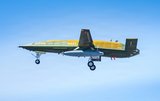
Boeing wins P-8A Poseidon aircraft order


Boeing has been awarded a $2.2 billion contract to produce at least 17 P-8A Poseidon aircraft for the US Navy, the Royal Australian Air Force (RAAF) and the Royal Air Force, the company announced on 3 April.
The contract, awarded on 30 March, also includes options for 32 P-8A additional aircraft as well as money for long-lead parts for future orders.
The US Navy will receive 11 P-8A aircraft, while Australia will receive four. The UK’s first two P-8A jets are part of the agreement, with first delivery scheduled for 2019.
Boeing so far has delivered 53 Poseidons to the US Navy and two to the RAAF.
The four aircraft for Australia are the additional aircraft announced in the Turnbull government’s Defence White Paper in 2016, and they take the total for the RAAF to 12 aircraft. The White Paper also forecast that a further three aircraft, for a total of 15, will be acquired early next decade.
A Boeing spokesperson said the 32 additional P-8As in the contract were earmarked for potential Foreign Military Sales (FMS) customers, but would not comment on whether two of the number are for the Royal New Zealand Air Force.
New Zealand is understood to have requested pricing and availability details for the possible acquisition of two P-8A aircraft. The Poseidon is under consideration for the RNZAF’s Future Air Surveillance Capability requirement, which will replace existing Lockheed P-3K2 Orions.
The P-8A is designed for advanced anti-submarine, anti-surface warfare and intelligence, surveillance and reconnaissance missions. The US Navy has deployed multiple squadrons globally since 2013, accumulating over 96,000 flight hours.
Related Equipment in Defence Insight



More from Naval Warfare
-
![Poland’s naval modernisation plans point to $13 billion market]()
Poland’s naval modernisation plans point to $13 billion market
Poland is reshaping its naval capabilities through investments in surface and undersea fleets, with further procurement opportunities expected into the 2030s.
-
![Autonomy gives Turkey a chance to outflank established naval shipbuilders]()
Autonomy gives Turkey a chance to outflank established naval shipbuilders
Turkish shipbuilders have sold ships from Asia to Europe, but autonomy and swarm technology could give them a fairer fight against Western European rivals.
-
![Canada assesses security equipment changes for Polar Icebreaker Imnaryuaq]()
Canada assesses security equipment changes for Polar Icebreaker Imnaryuaq
The Canadian Department of National Defence is evaluating communications and reconnaissance changes for CCGS Imnaryuaq’s expanded maritime security role, while retaining its 2032 acceptance target.
-
![US Navy’s MQ-25 Stingray approaches carrier-integration tests]()
US Navy’s MQ-25 Stingray approaches carrier-integration tests
Boeing has outlined its upcoming precision-landing and carrier-airspace trials as MQ-25 manufacturing shifts towards Illinois, with initial Lot 1 deliveries expected in 2029.