BAE Systems to modernise USS Wasp again
For the second time in four years, Wasp is undergoing work to sustain its warfighting capability


BAE Systems has received a $197.4 million contract from the USN for drydock, maintenance and modernisation of the amphibious assault ship USS Wasp (pictured) at its shipyard in Norfolk, Virginia.
If all options are exercised on the contract, its cumulative value will rise to $237.7 million.
BAE Systems will begin working aboard the 843ft-long USS Wasp in February 2021 to conduct hull, tank and mechanical work.
Wasp previously underwent maintenance availability with BAE Systems from December 2016 to May 2017, when the company added modifications to support operations with the F-35.
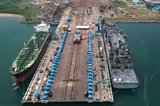
To prepare for drydocking Wasp this time, BAE Systems sent its largest floating drydock (Titan) to a Baltimore shipyard for five months of lifecycle maintenance. This will enable the Norfolk shipyard to service the largest USN ships ‘for another 20 to 25 years’, according to the company.
Titan is capable of lifting up to 52,500 long tons, while USS Wasp displaces about 40,500 long tons. It is the first in its class of eight vessels, but Shephard Defence Insight notes that these ships will be replaced by the America class.
As part of our promise to deliver comprehensive coverage to our Defence Insight and Premium News subscribers, our curated defence news content provides the latest industry updates, contract awards and programme milestones.
Related Equipment in Defence Insight



More from Naval Warfare
-
![Babcock onshores 85% of Canada’s submarine supply chain as it eyes future CPSP programme]()
Babcock onshores 85% of Canada’s submarine supply chain as it eyes future CPSP programme
By moving most of the Royal Canadian Navy’s submarine supply chain into Canada, Babcock Canada is driving to strengthen sovereign sustainment capabilities while preparing to compete to maintain the future Canadian Patrol Submarine Project.
-
![From the seas to the web: the changing shape of UK defence in Southeast Asia]()
From the seas to the web: the changing shape of UK defence in Southeast Asia
As his final engagement before leaving his post as the head of the British defence staff for Southeast Asia and defence adviser to Singapore, Brigadier Eddie Maskell-Pedersen spoke with Shephard about maritime security, cyber cooperation and long-term partnerships.
-
![Baltic naval priorities shift towards mine warfare and versatile platforms]()
Baltic naval priorities shift towards mine warfare and versatile platforms
Baltic states are investing in mine warfare, uncrewed systems and multirole platforms as major warship purchases remain scarce, industry sources indicate.
-
![India’s mine countermeasure drive triggers rush of new partnerships]()
India’s mine countermeasure drive triggers rush of new partnerships
Parallel procurement pathways for crewed mine countermeasure vessels and uncrewed systems underline a shift towards next-generation mine warfare for the Indian Navy.