Australia expands western shipbuilding precinct and sidelines Luerssen
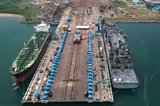
An aerial view of the existing Austal shipyard in the northern part of the Henderson defence precinct in Perth. (Photo: ADF)
Australia’s investment in naval infrastructure will aim to support its expanding fleet and will focus on the Henderson naval shipbuilding precinct, but challenges remain as Luerssen exits the market due to delays in the Arafura-class project.


As Australia prepares to induct nuclear-powered attack submarines (SSN) and expand its surface combatant fleet, the government is cueing up infrastructure improvements to permit the country’s naval build-up.
Canberra announced last month that it would be pouring billions of dollars into expanding the Henderson naval shipbuilding precinct in Perth, Western Australia (WA). The site will handle construction of eight general-purpose frigates, 18 medium and eight heavy landing craft and six large optionally crewed surface vessels, as well as depot-level SSN maintenance, for the Royal Australian Navy (RAN).
The government has said it would spend A$127 million (US$84 million) over the
Our news & analysis is now part of Defence Insight®
A Basic-level or higher Defence Insight subscription is now required to view this content.


More from Naval Warfare
-
![Babcock onshores 85% of Canada’s submarine supply chain as it eyes future CPSP programme]()
Babcock onshores 85% of Canada’s submarine supply chain as it eyes future CPSP programme
By moving most of the Royal Canadian Navy’s submarine supply chain into Canada, Babcock Canada is driving to strengthen sovereign sustainment capabilities while preparing to compete to maintain the future Canadian Patrol Submarine Project.
-
![Naval primes dive into an underwater acquisition gold rush]()
Naval primes dive into an underwater acquisition gold rush
A cluster of acquisitions by Fincantieri, Thales, Lockheed Martin and Rheinmetall points to a race to secure underwater warfare, autonomy and sensing capability.
-
![Baltic naval priorities shift towards mine warfare and versatile platforms]()
Baltic naval priorities shift towards mine warfare and versatile platforms
Baltic states are investing in mine warfare, uncrewed systems and multirole platforms as major warship purchases remain scarce, industry sources indicate.
-
![India’s mine countermeasure drive triggers rush of new partnerships]()
India’s mine countermeasure drive triggers rush of new partnerships
Parallel procurement pathways for crewed mine countermeasure vessels and uncrewed systems underline a shift towards next-generation mine warfare for the Indian Navy.