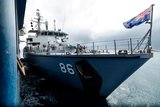
Austal completes autonomy trials with former Royal Australian Navy patrol boat
The ship used was the former HMAS Maitland. (Photo: Austal)
The work took place under the Patrol Boat Autonomy Trial (PBAT), which has been a collaboration between Austal, Greenroom Robotics, the Trusted Autonomous Systems Defence Cooperative Research Centre and the Royal Australian Navy’s (RAN) Warfare Innovation Navy Branch.


Australian ship builder Austal has completed autonomous and remote navigation sea acceptance trials (including endurance trials) of the former RAN Armidale-class patrol boat HMAS Maitland under the collaborative PBAT project.
The trials consisted of a series of events conducted off the Western Australian coastline during March and April 2024 using Greenroom Robotics’ Advanced Maritime Autonomy (GAMA) software to navigate and control the ship, now christened Sentinel.
PBAT was formed as a collaboration to establish robotic, automated and autonomous elements on a former navy patrol boat and to provide a proof-of-concept demonstrator for optionally crewed or autonomous operations. The trial has also explored the legal, regulatory pathways and requirements of operating an autonomous vessel.
In 2022, Austal took possession of the decommissioned ship from the Commonwealth of Australia and commenced planning, modification, testing and evaluation of autonomous and remotely operated systems for the PBAT. At 57m, Sentinel has become the largest vessel operated in Australia to be operated remotely and autonomously.
Sentinel was extensively modified to enable remote and autonomous operations, including modifications to navigation, communications, bilges, CCTV and electrical systems. Sensors and computer units were also added by Greenroom Robotics to inform and host GAMA.
The core objectives of PABT have been to increase understanding of autonomous fuel management, communication and navigation systems; investigate and understand the sustained operation of shipboard mechanical systems; and provide input to long-term risk reduction for future naval projects.
Related Equipment in Defence Insight



More from Naval Warfare
-
![Competitive P17B tender marks a shift in Indian Navy frigate procurement]()
Competitive P17B tender marks a shift in Indian Navy frigate procurement
The Indian Navy's P17B programme is expected to combine greater weapons capacity with a competitive domestic construction model, although key systems could remain dependent on international supply chains.
-
![How France’s SNLE 3G programme is reshaping the naval nuclear industrial base]()
How France’s SNLE 3G programme is reshaping the naval nuclear industrial base
Extending far beyond a four-submarine replacement programme, France’s ballistic missile submarine effort is a decades-long industrial initiative designed to preserve the country’s ability to build and sustain nuclear-powered strategic platforms.
-
![China’s mineral processing dominance exposes naval supply chain vulnerabilities]()
China’s mineral processing dominance exposes naval supply chain vulnerabilities
Competition for critical minerals, and China’s dominance of their processing, is emerging as a decisive factor in future naval procurement programmes.
-
![Suppliers await next step in Australia’s mine warfare transition]()
Suppliers await next step in Australia’s mine warfare transition
Australia’s mine countermeasure capability remains in flux as the Huon-class nears retirement, but accelerated investment in autonomous systems is opening a path for industry.
-
![Can the US Navy ask Indo-Pacific allies to do more while training with them less?]()
Can the US Navy ask Indo-Pacific allies to do more while training with them less?
As the Iran War draws US ships and marine corps units away from the Indo-Pacific, curtailed exercises and a temporary carrier gap are exposing tensions between Washington’s demand for more self-reliant allies and the joint training needed to realise that ambition.