Aegis weapon system successfully intercepts two short-range ballistic missile targets
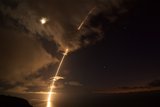
Missiles fired from the Pacific Missile Range Facility, located on Kauai, Hawaii, were intercepted by a ship using the Baseline 9 Aegis Combat System. (Photo: Missile Defense Agency)
The Vigilant Wyvern joint test saw USN Arleigh Burke-class destroyer USS Carl M Levin detect, track, engage and execute missiles fired from the Pacific Missile Range Facility, located on Kauai, Hawaii.


The US Navy's Arleigh Burke-class destroyer USS Carl M Levin successfully intercepted multiple targets in an Integrated Air and Missile Defense (IAMD) test executed by the USN Program Executive Office Integrated Warfare Systems and the Missile Defense Agency (MDA).
The ship is fitted with Baseline 9 Aegis Combat System and this was a key part of the exercise which was described in a statement as ‘an Anti-Air Warfare (AAW) engagement of two subsonic anti-ship cruise missile drone targets.’
‘The test, designated Flight Test Aegis Weapon System-48 (FTM-48) by the MDA, demonstrated the IAMD engagement of two short-range ballistic missile (SRBM) targets with two Standard Missile 3 Block IA (SM-3 Blk IA) interceptors, and engagement of two subsonic anti-ship cruise missile drone targets with four SM-2 Blk IIIA interceptors.’
As part of the IAMD Priority Mode, ships can integrate classic air defence with new discrimination and tracking capabilities to defend against coordinated, simultaneous missile attacks.
Seiko Okano, program executive officer – integrated warfare systems for RDML, said: ‘The success of Vigilant Wyvern is a huge milestone. This test event is the first of its kind and an excellent example of collaboration between organizations, further progressing a unified mission to increase capability.’

More from Naval Warfare
-
![HMS Anson’s milestone stay in Australia cut short during AUKUS deployment]()
HMS Anson’s milestone stay in Australia cut short during AUKUS deployment
The Astute-class submarine’s visit to Australia was the first time maintenance activity on a UK Royal Navy nuclear submarine had been carried out in the country.
-
![How Operation Epic Fury could reduce US readiness to face China]()
How Operation Epic Fury could reduce US readiness to face China
The offensive against Iran could impact training and maintenance cycles and accelerate the degradation of the US arsenal on top of depleting Washington’s stockpiles.
-
![UK Royal Navy explores modular counter-drone capabilities for future hybrid fleet]()
UK Royal Navy explores modular counter-drone capabilities for future hybrid fleet
The UK MoD is scoping out systems to counter the growing threat of uncrewed aerial systems, with a focus on low-cost modularity and speed to field.