XM30 progress is ‘looking good’ according to US Army project office
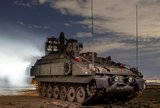
American Rheinmetall Vehicles is competing for the US Army’s XM30. (Image: American Rheinmetall Vehicles)
The XM30 is one of several vehicle replacement programmes coming down the line for US forces and the most recent effort to replace Bradley infantry fighting vehicles.


The US Army is confident that after several failed attempts to replace its fleet of Bradley infantry fighting vehicles (IFVs) it is now on track with the Optionally Manned Fighting Vehicle (OMFV) programme or XM30.
General Dynamic Land Systems (GDLS) and American Rheinmetall Vehicles (ARV) have been competing for the requirement under contracts worth a total of US$1.6 billion awarded in June 2023.
Previous efforts have struggled, including the programme being reset in October 2019 when only GDLS bid after BAE Systems and Rheinmetall dropped out. Procurement officials have expressed confidence that the programme is on track.
Col Jeffrey Jurand,
Our news & analysis is now part of Defence Insight®
A Basic-level or higher Defence Insight subscription is now required to view this content.




More from Land Warfare
-
![Europe commits to long-range fires but countries move in different directions]()
Europe commits to long-range fires but countries move in different directions
Sweden, Croatia and France are pursuing different rocket artillery solutions as European armies seek greater reach, survivability and industrial resilience.
-
![Polaris expands Arctic mobility offering as US military orders grow]()
Polaris expands Arctic mobility offering as US military orders grow
The Military 850 Voyageur 155 Crossover has secured orders from the US Army, Air Force and Marine Corps, addressing demand for agile Arctic mobility with passenger, cargo and towing capacity.
-
![Northrop Grumman pushing ahead with smaller Integrated Battle Command System]()
Northrop Grumman pushing ahead with smaller Integrated Battle Command System
Northrop Grumman’s Integrated Battle Command System is in service with Polish forces and is being introduced to US forces, with further development underway on the original platform as well as a smaller, more mobile system.
-
![UK’s ground-based air defence effort remains in assessment phase after third industry day]()
UK’s ground-based air defence effort remains in assessment phase after third industry day
The UK’s plan to introduce a new air defence capability into the British Army will cover short and medium-range defence as well as counter-uncrewed aerial system systems. Timelines are not yet laid out but industry is making plans.