World Defense Show 2026: Middle East remains focused on US equipment and local industry involvement
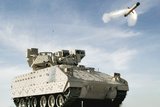
An Australian M1A2 SEPv3 Abrams taking part in a live fire trial; Bahrain has been approved to buy the same vehicles. (Photo: Australian DoD)
Vehicle procurement in the Middle East continues to target big-ticket main battle tanks, with lighter platform purchases also potentially on the horizon including tactical, infantry fighting and armoured personnel carrier vehicles.


The Middle East market for tracked and wheeled vehicles, including both contracted and unawarded, is valued at US$63.5 billion over the next decade, with almost half of this figure pertaining to 12 unawarded programmes at a total value of $31.7 billion.
The estimated spend, according to research from Shephard Defence Insight, covers 20,675 vehicles across all requirements and 9,871 vehicles in unawarded programmes.
The largest unawarded programmes are for main battle tanks (MBTs). Specifically, Bahrain’s estimated spend on MBTs is $2.2 billion, while future orders of the Altay MBT for Turkey are valued at $9.2 billion, along with $675 million for Saudi Arabia, $864
Our news & analysis is now part of Defence Insight®
A Basic-level or higher Defence Insight subscription is now required to view this content.

More from Land Warfare
-
![AUSA 2026: companies adapt munitions and missiles for greater effect at lower costs]()
AUSA 2026: companies adapt munitions and missiles for greater effect at lower costs
Rather than developing entirely new weapons, defence companies are looking to build on existing weapons and systems to deliver greater capability, control costs and accelerate fielding.
-
![AUSA 2026: CUAS market expands as suppliers target new threats and operational requirements]()
AUSA 2026: CUAS market expands as suppliers target new threats and operational requirements
New developments from MARSS, MyDefence, Mountain Horse Solutions and Rafael suggest that future counter-drone protection will increasingly depend on combining advanced detection, rapid interception and integrated defensive networks.
-
![US Army seeks CAML-Lite autonomous launcher prototypes for 2027 live-fire trials]()
US Army seeks CAML-Lite autonomous launcher prototypes for 2027 live-fire trials
The optionally crewed, C-130-transportable platforms would combine modular offensive and defensive fires with autonomous resupply, with demonstrations planned for Talisman Sabre 2027.