US Navy expects to complete delivery of VAMPIRE CUAS to Ukraine this month
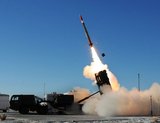
VAMPIRE CUAS will be delivered to Ukraine. (Photo: US Navy)
As the Ukraine continues to battle against Russia’s use of UAS in a range of sizes, the VAMPIRE CUAS will be used against higher-tier UAVs with the inclusion of a fuzed warhead.


The US Navy (USN) has said that it expects to deliver the last of the L3Harris Vehicle Agnostic Modular Palletized ISR Rocket Equipment (VAMPIRE) CUAS to Ukraine this month and the first-ever Advanced Precision Kill Weapon System (APKWS) with proximity fuze warheads for use with the system.
The system and warheads will be provided as part of a DoD aid package with the support of the Direct and Time Sensitive Strike programme office (PMA-242). The proximity fuze incorporates an RF sensor that enables APKWS to target Group 2 and Group 3 UAVs.
The USN and army have traditionally used APKWS against air-to-ground targets and with VAMPIRE, the laser-guided rocket can defend against uncrewed aerial threats.
Fourteen systems are being delivered by PMA 242 and the first four systems were delivered in the space of six months.
PMA 242 officials said the fast delivery of the system was done with the use of ‘innovative contracting strategies’ and ‘early reports indicate the weapon system is having an immediate impact in the ongoing Ukrainian wartime effort’.
The system has been described by the company as a ‘suitcase-type APKWS launcher and designator kit [which] provides a rapid solution for arming non-tactical vehicles and a variety of tactical vehicles, while integrating components to customer-specific specifications’.



More from Land Warfare
-
![Hanwha debuts with US Army deal worth up to $3.6 billion as it eyes future M109 replacement]()
Hanwha debuts with US Army deal worth up to $3.6 billion as it eyes future M109 replacement
The Mobile Tactical Cannon is to replace the US Army’s M777 towed howitzers which could result in the procurement of almost 500 systems at an estimated $3.59 billion.
-
![Rheinmetall advances longer 155mm ordnance with 30% range increase]()
Rheinmetall advances longer 155mm ordnance with 30% range increase
Rheinmetall has begun initial firing trials of a new 155mm/60-calibre artillery ordnance that could deliver up to 30% greater range than its existing 155mm/52-calibre system, as production of the current gun expands across Germany and the UK.
-
![Boxer lands another order as contracts and opportunities build momentum]()
Boxer lands another order as contracts and opportunities build momentum
As Germany prepares its €25 billion order under the Arminius framework – the biggest Boxer procurement to date – the platform could become an increasingly powerful contender in European competitions.
-
![Trans-European iMUGS2 uncrewed systems programme set for three-day exercise in 2028]()
Trans-European iMUGS2 uncrewed systems programme set for three-day exercise in 2028
The next stage of the Integrated Modular Unmanned Ground System (iMUGS) programme, dubbed iMUGS2, was launched in November 2025. Three major demonstrations are planned before the end of 2028.
-
![British Army Land Rover replacement plan inches forward]()
British Army Land Rover replacement plan inches forward
The UK Ministry of Defence has proposed a selection date of May 2027 for the Land Rover replacement requirement, with deliveries expected through to 2036. Next month’s DVD exhibition will be a key shop window for bidders.