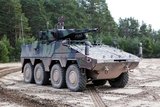
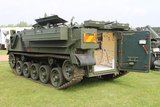
AJAX turret in manned live fire testing


Manned live fire testing of the turret developed for the British Army’s Ajax vehicle has begun, Lockheed Martin UK announced on 6 November.
The initial testing began in October in west Wales. The formal qualification trials will include testing of the vehicle’s CTAI 40mm (CT40) cannon and the 7.62mm chain gun.
The initial phase tested firing from a static vehicle on a static target. The trials will continue over the coming months, progressing to fire on the move at a moving target. The manned firing will generate data to support manned crew clearance processes – assessing the safety and suitability of the platform for use by military personnel.
Lee Fellows, programme director for Ajax at Lockheed Martin UK, said: ‘This is a huge milestone for us and for the Ajax programme.
‘The Ajax firings have been successful and we are confident they will continue to be so as we progress through the trial. It’s another step towards getting this world-class capability to the British Army.’
The AJAX turret, developed by Lockheed Martin UK, shares commonality with the upgraded turret for the Ministry of Defence’s Warrior Capability Sustainment Programme.
Related Equipment in Defence Insight


More from Land Warfare
-
![Dominating the spectrum: ASELSAN’s EW capabilities take center stage at MSPO 2026]()
Dominating the spectrum: ASELSAN’s EW capabilities take center stage at MSPO 2026
ASELSAN is showcasing its advanced electronic warfare (EW) capabilities at MSPO 2026, highlighting technologies designed to detect, analyse, disrupt and deceive threats across increasingly contested electromagnetic environments.
-
![“Creating a decision advantage”: how C-UAS is evolving to reduce the operator burden]()
“Creating a decision advantage”: how C-UAS is evolving to reduce the operator burden
In Conversation… Speaking to Shephard’s Gerrard Cowan, Dr Brian Shand, Director – Advanced Concepts & Technology at L3Harris, explains how, as operators face growing numbers of low-cost drones, C-UAS providers must focus on reducing operator workload, transforming fragmented sensor data into effective decision-making.
-
![August land forces roundup: movement in British Army vehicle requirement and major contracts land]()
August land forces roundup: movement in British Army vehicle requirement and major contracts land
Hanwha Defense USA made major inroads into the US market this month, landing its first contract in the country, while Germany and The Netherlands signed up for more Boxer CRT30 8x8 infantry fighting vehicles. FNSS also unveiled a new amphibious uncrewed vehicle and Rheinmetall revealed details on a prototype 155mm/60-calibre artillery ordnance.
-
![British Army faces AFV capability gaps despite Boxer and Ajax deliveries]()
British Army faces AFV capability gaps despite Boxer and Ajax deliveries
The British Army continues to face gaps in its armoured fighting vehicle fleet, with replacement plans for Warrior and FV432 still unresolved despite ongoing deliveries of Boxer and Ajax.