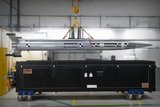
Ukraine test fires Neptune cruise missile


The National Security and Defence Council of Ukraine has confirmed that the Armed Forces have carried out a successful test of the Neptune ground-based cruise missile system.
State Enterprise “Luch” Kyiv State Design Bureau conducted the launch on 2 April at the Alibey landfill site in the Odessa region.
Neptune is designed to enhance the cruise missile combat capabilities of the Ukrainian Navy in the Black Sea and Azov Sea with the ability to destroy corvettes, cruisers, frigates and destroyers.
It has been a key priority for the Ukrainian Ministry of Defence and the General Staff of the Armed Forces to develop an indigenously designed cruise missile system.




More from Land Warfare
-
![“Timelines are measured in seconds”: tackling the UAS threat with dispersed defences]()
“Timelines are measured in seconds”: tackling the UAS threat with dispersed defences
Small uncrewed aerial systems (UAS) have transformed the battlespace, posing a complex threat across all domains. Militaries now need counter-UAS (CUAS) capabilities that defeat the danger while meeting demands around readiness, manoeuvrability and adaptability, according to Mike Spina, Director, Global Sales and Business Development for Targeting and Sensor Systems (TSS) at L3Harris Technologies.
-
![“No single technology is enough”: why an integrated approach to uncrewed warfare is essential]()
“No single technology is enough”: why an integrated approach to uncrewed warfare is essential
In Conversation… Ahmet Akyol, CEO of ASELSAN, talks to Shephard’s Gerrard Cowan about how the rapid evolution of uncrewed aerial systems (UAS) is transforming the battlespace, with militaries focused on both deploying these platforms to maximum effect and developing the defensive systems needed to counter them.
-
![Lasers heat up for counter-drone option as DroneLight tackles the big question]()
Lasers heat up for counter-drone option as DroneLight tackles the big question
Using lasers to defeat drones promises to solve the dilemma of using expensive kinetic effects to kill platforms worth a few hundred dollars. While maintaining thermal output to provide the effects can be a technical hurdle, Israel’s Esh-Tech is one company working on a solution.
-
![How Pearson Engineering combines tradition with innovation for the demining mission (Video)]()
How Pearson Engineering combines tradition with innovation for the demining mission (Video)
At Eurosatory 2026, Pearson Engineering's Group CEO Ian Bell talked about the company's role in delivering specialist armoured engineering, route-clearance and demining capabilities to military customers around the world.
-
![France’s artillery rocket competition aims for sovereign solution as contest enters decisive phase]()
France’s artillery rocket competition aims for sovereign solution as contest enters decisive phase
France’s requirement for a replacement MLRS is intended to provide the country with a sovereign capability to bolster the country’s strategic autonomy, with a final platform expected to be in service by 2030.