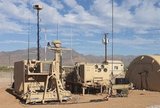
TOW capabilities enhanced


Raytheon has announced that it has tested a new propulsion system for the Tube-Launched, Optically-Tracked, Wireless (TOW) missile. The enhanced system, developed by ATK, doubles TOW’s range and reduces the missile’s flight time by one-third.
Raytheon reported that during the test, the developmental propulsion system flew the missile more than seven kilometres (4.35 miles), reaching four kilometres (2.5 miles) in significantly less time.
Raytheon and ATK’s Missile Products Group worked closely to develop a propulsion system that improves the performance of the TOW missile. The launch, boost, sustain (LBS) propulsion system also incorporates a rocket motor designed with Insensitive Munitions (IM) features to provide added safety: IM compliant systems are less likely to react explosively when subjected to bullet and fragment impacts, external fire or other hazardous events.
The TOW system has been employed by US forces in every conflict since Vietnam and continues to be used today in Afghanistan. It is a command line-of-sight system that requires the gunner to track the target until the missile impacts. The tube-launched, optically-tracked, wireless-guided (TOW) weapon system, with the multi-mission TOW 2A, TOW 2B, TOW 2B Aero and TOW Bunker Buster missiles, is the premier long-range, precision anti-armour, anti-fortification and anti-amphibious landing weapon system used throughout the world today.


More from Land Warfare
-
![Europe commits to long-range fires but countries move in different directions]()
Europe commits to long-range fires but countries move in different directions
Sweden, Croatia and France are pursuing different rocket artillery solutions as European armies seek greater reach, survivability and industrial resilience.
-
![Polaris expands Arctic mobility offering as US military orders grow]()
Polaris expands Arctic mobility offering as US military orders grow
The Military 850 Voyageur 155 Crossover has secured orders from the US Army, Air Force and Marine Corps, addressing demand for agile Arctic mobility with passenger, cargo and towing capacity.
-
![Northrop Grumman pushing ahead with smaller Integrated Battle Command System]()
Northrop Grumman pushing ahead with smaller Integrated Battle Command System
Northrop Grumman’s Integrated Battle Command System is in service with Polish forces and is being introduced to US forces, with further development underway on the original platform as well as a smaller, more mobile system.